Someone watches a video of a blanket being made, searches the phrase they half-remember, and ends up with a 35 cm aluminium Tunisian hook in the post. The pattern they actually wanted was a standard granny square worked with a 5 mm hook. The tool arrives, the first row goes on fine, and then the whole thing refuses to turn — because a Tunisian hook does not turn, and nothing in the pattern explains why. The yarn goes back in the bag.
The phrase covers at least four separate crafts, each with a different tool and a different fabric. By the end of this you will know which one your pattern is asking for, what the tool costs you in setup, and how to tell a crochet fabric from a knitted one at a glance — before you spend money on the wrong thing.
1. Hook-Based Crochet: One Live Loop, One Tool
Crochet uses a hook, not a needle. That is the short answer to the question most people arrive with, and it holds for roughly ninety per cent of the patterns sold as crochet: single crochet, double crochet, granny squares, amigurumi, ripple blankets. One loop sits live on the hook at a time, every stitch is finished before the next begins, and you can put the work down mid-row without anything unravelling.
The fabric gives it away. Crochet stitches stack into visible posts with gaps between them, the edges are firm enough to hold their shape without blocking, and the fabric is thicker for the same yarn than a knitted one. Hold a double crochet swatch up to a window and you see light through regular holes. That density is why crochet eats yarn — expect a third more metres than a knitted version of the same square.
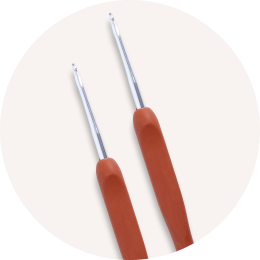
Hook sizes run from 2 mm up to 12 mm and beyond, and the size printed on the handle is the shaft diameter, not the throat. Two hooks marked 5 mm from different makers can give you a different gauge, which is exactly why every pattern asks you to swatch first.

From the Hooks & Needles shop
Crochet Hook Set 16 Pcs with Case
If it turns out ordinary hook-based crochet is what you were looking for, a graded set means you can go up or down a size to hit gauge instead of abandoning the pattern.
2. Tunisian Crochet: The Long Hook That Gets Called an Afghan Needle
A tunisian crochet hook looks like a hook that has been stretched — a normal head, then a straight shaft 25 to 35 cm long, finished with a stopper or a flexible cable. The reason for the length is that you keep every loop of the row on the shaft rather than closing each stitch as you go. A 40-stitch row means 40 live loops sitting there at once.
Every row is worked twice. The forward pass picks up loops across the row; the return pass works them off two at a time. You never turn the work, which is the single fact that trips up crocheters coming from standard patterns, because the right side faces you the whole time.
The fabric that comes out is denser and flatter than regular crochet, with a woven, cross-hatched surface. Tunisian simple stitch in particular makes excellent blankets and dishcloths, and terrible drapey garments unless you go up two hook sizes from what the yarn band suggests.
3. Knitting That People Mistake for Crochet
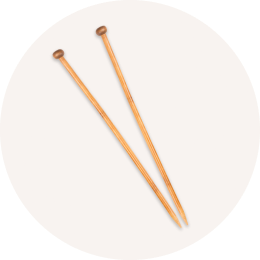
Two needles, two pointed ends, a whole row of live stitches on each — that is knitting, and a fair share of searches for this phrase are people describing knitting with the wrong word. The tell is the fabric: knitted stockinette shows rows of interlocking Vs on the front and horizontal ridges on the back. There are no posts and no gaps.
Knitting needles come straight, circular or double-pointed, and sizes are the same millimetre scale as hooks. A 5 mm needle and a 5 mm hook are the same diameter and produce completely different fabric, which is the honest answer to the needle vs hook question — the tool determines the structure, not just the size.
- Look at the surface. Rows of small Vs mean knitting; visible vertical posts with spaces between them mean crochet.
- Check the working edge. A whole row of loops held on something is knitting or Tunisian. One single loop is standard crochet.
- Count the tools in shot. Two pointed sticks is knitting. One hooked stick, long or short, is crochet of some kind.
- Watch for the turn. If the work flips at the end of every row, it is knitting or regular crochet — never Tunisian.
Mute the video and watch the hands for thirty seconds. Tutorial narration is where the vocabulary gets muddled, so the hands are more reliable than the voiceover every time.
If you are choosing between the two crafts rather than identifying one, the practical differences in speed, fixability and hand strain are laid out in this comparison of which craft to start a new maker on. For working in the round, a  55 Pcs Double Pointed Knitting Needle Set covers socks, sleeves and hat crowns.
4. Knooking and the Tapestry Needle: Crochet With a Needle, Literally
Knooking uses a hook with a hole drilled in the handle and a cord threaded through it. You form stitches with the hook exactly as a crocheter would, then slide the row onto the cord instead of a needle shaft. The fabric that comes off is knitting — real stockinette, real garter, indistinguishable from needle work once it is blocked.
It solves a specific problem: people who find two needles awkward but want knitted drape. The trade-off is speed. Knooking runs noticeably slower than either parent craft, and the cord has to be threaded through every row.
The other genuine needle in this craft is the blunt tapestry needle, and it is the only one you will use in ordinary crochet. It has a large eye, a rounded tip that slides between plies instead of splitting them, and it handles seaming, weaving in ends and duplicate stitch. If someone says they are about to crochet with a needle and they are holding something blunt with an eye, they are finishing, not making.
5. Common Needle Crochet Mistakes (And the Fix)
Buying a Tunisian hook for a standard pattern. The fix is to read the first row instruction: if it tells you to turn your work, put the long hook away and use a regular one. Turning and Tunisian are mutually exclusive.
Assuming a 5 mm hook and a 5 mm needle give the same gauge. They do not, because the stitch structures are different heights and widths. Swatch 15 cm square in the stitch the pattern names, measure the middle 10 cm, and change tool size — never tension — to correct it.
Using a sharp sewing needle to weave in ends. A sharp tip splits the plies and locks the tail in place where it will eventually work through to the right side. Swap to a blunt tapestry needle and weave along the path of a stitch, not across it.
Blaming your hands for uneven stitches. A hook whose throat has worn smooth or whose coating has flaked drags in a way no amount of practice fixes, as this piece on how worn hooks and needles change every stitch explains. Run a fingernail down the shaft; if it catches, replace the tool.
Skipping the swatch on Tunisian work because it "looks about right". Tunisian fabric shrinks in width and grows in length after blocking, sometimes by two full centimetres over 20. Wet-block the swatch and measure it dry before you cast on for anything sized.
Here is a one-minute walkthrough of the double crochet stitch, filmed close enough to see the single live loop that separates hook-based crochet from everything else on this list.
DOUBLE CROCHET FOR COMPLETE BEGINNERS
Ready to start a project you will actually finish?
Hooks & Needles delivers a complete yarn project to your door every month — coordinated yarn, the right hooks or needles, and a pattern written to be followed rather than decoded. Pause or cancel whenever you like.
Use LEARN20 for 20% off your first box

Closing Thoughts
Most people arrive at this phrase wanting ordinary crochet and a 4 mm or 5 mm hook. A smaller group wants Tunisian, and they need the long shaft plus a willingness to work every row twice. A third group has been describing knitting all along.
Work a swatch in each before you commit to a big project. Twenty minutes and ten metres of yarn will tell you more than another hour of reading, and it costs nothing but a scrap ball.
Material matters too once you know which tool you need — grip, warmth and how much the yarn slides differ, which is covered in this look at bamboo versus metal hooks and needles.
What to remember
- Standard crochet uses one hook and holds exactly one live loop.
- A Tunisian hook holds a full row of loops and the work never turns.
- Two pointed needles and a fabric of small Vs means you are looking at knitting.
- The only needle in ordinary crochet is the blunt tapestry needle for seaming and ends.
- Match tool size to gauge by swatching 15 cm and measuring the middle 10 cm.
FAQ
Do you use a needle or a hook for crochet?
A hook. Every standard crochet stitch is formed by pulling yarn through a loop with a hooked tip, and only one loop stays live at a time. The single exception is the blunt tapestry needle used for seaming and weaving in ends after the crocheting is finished.
Can I work a Tunisian pattern with a regular crochet hook?
Only for very narrow pieces, up to about 15 stitches, because a standard 15 cm hook cannot hold more loops than that without them sliding off the handle end. For anything wider you need a long shaft or a hook with a cable attached.
How do I know which tool a pattern wants if it just says "5 mm"?
Read the stitch abbreviations. If you see sc, dc, tr or ch, it is a hook. If you see k, p, yo or ssk, it is needles. If it says TSS or tells you never to turn, it is Tunisian.
My gauge is right on width but wrong on height. Which tool do I change?
Neither, usually. Row height in crochet is governed by how far you pull up your loop before completing the stitch, so practise a consistent loop height on a 10 cm swatch. Changing hook size will throw off the width you already have correct.
I bought the wrong tool. Is there anything worth making with it?
A long Tunisian hook makes excellent washcloths, placemats and straight-edged blanket panels, all of which suit its dense fabric. A spare pair of needles handles garter-stitch dishcloths and simple scarves. Neither purchase has to become a drawer ornament.