Quick Summary
You want to buy one hook that works, not a rainbow set of twelve you will never fully use. This walks through the four decisions that actually change how a hook behaves in your hand — head shape, material, handle and size — and matches each one to the problem it solves. If your yarn keeps splitting or your hand aches by the end of a podcast episode, the hook is probably the reason.
Picture the beanie that never got finished. You bought the 5 mm hook the pattern called for, wound up a soft acrylic in a colour you loved, and forty minutes in the stitches looked shaggy because the hook kept spearing through the plies instead of sliding under them. Your grip tightened to compensate. By the second evening your thumb joint was complaining and the project went in a bag.
None of that was a skill problem. Hooks differ enormously in ways the size number never tells you — how pointed the tip is, how deep the throat cuts, how much friction the surface has, how much the handle spreads the load across your hand. Get those four right for the yarn you actually use, and stitches start landing where you meant them to.
To see how the head of the hook enters a stitch and catches the yarn at normal working speed, this one-minute double crochet demonstration shows it plainly.
DOUBLE CROCHET FOR COMPLETE BEGINNERS
1. Head Shape: The Four Profiles Behind Inline and Tapered
Every hook head is a combination of two things: the shape of the shaft under the hook, and the sharpness of the point. The shaft is either inline — the hook carved straight down into a cylinder, so the tip sits flush with the shaft below it — or tapered, where the shaft narrows and swells outward before the hook, so the head juts slightly forward. Cross those with a pointed or a rounded tip and you get four genuinely different tools.
The throat is the narrow scoop between the tip and the shaft, and it is where the loop sits while you pull through. A deep, straight throat holds a loop at a fixed size. A shallow, sloped one lets the loop ride up onto the wider shaft and stretch.
- Inline with a pointed tip: most accurate into tight stitches and dense fabric. Splits soft plied yarn if you drive it rather than guide it.
- Inline with a rounded tip: the most even gauge of the four, because the loop cannot creep up a widening shaft. Slower into stiff cotton.
- Tapered with a pointed tip: fast, glides through acrylic, and very good at finding the gap in a granny square. Loosest tension of the four.
- Tapered with a rounded tip: the gentlest on loosely spun and fluffy yarn. Fiddly in linen stitch or anything worked into the back loop only.
Splitting yarn is almost always a point problem. If your hook keeps piercing the strand instead of passing under it, you want a rounder tip, and you want to slow the moment of entry rather than change your whole grip.
2. Material: Aluminium, Bamboo and Plastic Do Different Jobs
Friction is the whole argument. Aluminium is slick and cold, so yarn slides off it quickly; bamboo and wood have a soft grab that holds a loop still; plastic and resin sit somewhere in the middle and are usually the lightest of the three in the larger sizes.
Sticky acrylic is the classic case for metal. Cheaper acrylic has a slightly rough surface that drags against wood, and each stitch costs you a small tug — multiply that across a blanket and your forearm knows about it. A polished aluminium hook such as the  Aluminum Crochet Hooks 12 Pcs removes that drag entirely.
Slippery yarn wants the opposite. Bamboo, mercerised cotton blends and anything silky behave far better on a wooden surface, because the loop stays where you put it between stitches instead of sliding loose. If you crochet tightly, metal will fight you; if you crochet loosely, wood will quietly tidy your fabric up.
Does material change my gauge, or only how the hook feels?
It changes gauge, usually by a small but real amount. A grippier surface tends to produce slightly tighter, more even stitches because the working loop does not slip, while slick metal lets loops sit a fraction larger. Swatch with the hook you intend to use for the whole project, not the one nearest the sofa.
There is no neutral material, only one that suits the yarn in front of you. The practical differences between bamboo and metal tools come down to speed versus control, and most crocheters eventually keep one of each in their two most-used sizes.
3. Handle: What Actually Stops Hand Pain After an Hour
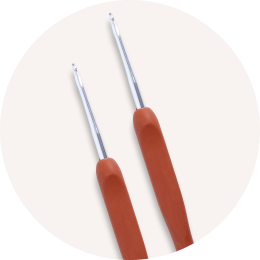
Pain after an hour is a grip-width problem before it is anything else. A bare hook is roughly pencil-thin, which forces your fingers into a pinch and asks a few small muscles to hold the whole load. A wider handle spreads that across the palm, and an ergonomic crochet hook — the ones with a flattened or bulbed grip — works because of that width, not because of the shape being clever.
Weight matters second. Warmer, lighter tools like the  Bamboo Crochet Hooks 12 Pcs ask less of the hand over long sessions, and they do not chill your fingers the way metal does in a cold room.
Your grip style decides the rest. Pencil grip, with the hook held like a pen, wants a flat thumb rest to stop rotation. Knife grip, with the hook held overhand, wants bulk in the palm and cares very little about the thumb rest.
Try both for ten minutes before you decide you know which one you use. Most people switch unconsciously depending on the stitch.
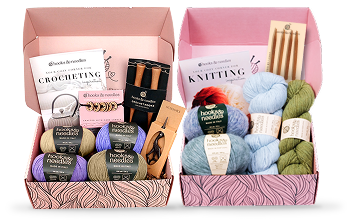
Want the yarn, the pattern and the guidance in one box?
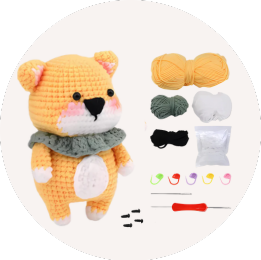
Each Hooks & Needles box arrives with the yarn, the tools and an exclusive pattern already matched to each other, plus instructions that do not skip the step you are stuck on. Nothing to source, nothing to substitute.
Use LEARN20 for 20% off your first box

4. Size: Choosing One Crotchet Hook Instead of a Whole Set
Pick the yarn first and the number follows. Yarn weight categories run from lace and 4-ply up through DK, aran, chunky and super chunky, and each one has a narrow band of hook sizes that produces fabric with the right drape. Buy for the yarn you reach for most, not for the whole range you might one day use.
If you are choosing a single hook to learn on, a 5 mm or 5.5 mm worked with a smooth aran-weight yarn is the most forgiving combination there is. Stitches are big enough to see, the fabric grows quickly, and mistakes are easy to read back. That is the honest answer to what the best crochet hook for beginners looks like — one size, matched to one yarn, rather than a set of twelve.
Chunky and super chunky yarns are the one case for buying outside your usual range, because nothing smaller will open the fabric up — a set of  Large Crochet Hooks for Chunky Yarn covers the sizes most standard packs stop short of.
Two hooks marked the same size can still behave differently, which catches people out mid-project. The measurement refers to the shaft diameter and says nothing about the head, so it is worth knowing why two 5 mm hooks can give two different gauges before you swap brands halfway through a sleeve.
Common Mistakes, and What to Do Instead
Buying a full set before knowing your grip
A twelve-piece set in one style commits you to that handle and that head shape across every size. Buy one hook in your most-used size, work a full project with it, then buy the set in whichever style your hands voted for.
Blaming tension when the hook is the cause
Uneven rows often come from a sloped throat letting the loop stretch, not from an inconsistent hand. Work ten rows with an inline hook before you try to retrain your grip; if the fabric evens out, the tool was the variable.
Using a pointed tip on fluffy or loosely spun yarn
Mohair, chenille and soft single-ply yarns split on sharp points no matter how careful you are. Switch to a rounded tip and let the hook find the space between plies rather than forcing it.
Keeping a hook long after the finish has worn
Coated aluminium and painted hooks develop rough patches that catch yarn, and worn wooden hooks go slightly sticky at the throat. Run the hook across your lip; if you feel any catch or ridge, retire it from anything where gauge matters.
Choosing the hook before choosing the yarn
The hook is the second decision, always. Settle the yarn and its weight category first, then pick the size band, then the head shape and material that suit that fibre.
Closing Thoughts
The hook that suits you is a specific combination, not a brand. Rounded tip for soft yarn, inline shaft for even gauge, metal for grabby acrylic, wood for anything slippery, and a handle wide enough that your thumb is not doing all the work.
Buy one at a time. Finish something with it before you buy the next, because the project tells you what the packaging cannot.
What to remember
- Splitting yarn means the tip is too pointed for that fibre — change the point, not your grip.
- Inline hooks hold a loop at a fixed size and give the most even gauge; tapered hooks are faster and looser.
- Slick aluminium for sticky acrylic, grippier bamboo or wood for slippery yarn.
- Hand pain after an hour is usually handle width, so widen the grip before you shorten your sessions.
- Choose the yarn first, then the size band, then the head shape and material.
FAQ
I already own a twelve-piece set. Do I need to buy anything else?
Not necessarily — work out which head shape your set has and which yarns it struggles with. If it splits your soft acrylic or your gauge wanders, add a single hook in the opposite style at your most-used size and compare directly. One well-chosen addition usually solves more than a second full set.
How do I tell whether the hook in my hand is inline or tapered?
Hold it side-on at eye level and look at where the tip sits relative to the shaft below it. Inline hooks have a tip flush with the shaft and a throat that cuts straight down; tapered hooks have a tip that noses forward past a narrowed neck. Once you have seen both together the difference is obvious.
My gauge changed after I switched hooks mid-project. Can I save it?
Measure both sections before deciding. If the difference is under half a stitch per 10 cm, blocking will usually even it out; if it is more than that, frog back to the switch point and redo it with one hook. Marking which hook a project uses and keeping it in the bag prevents the repeat.
Does any of this apply to knitting needles?
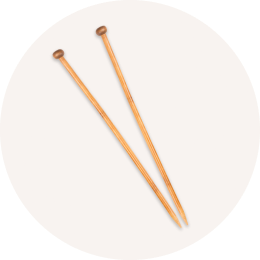
Material and weight carry straight over — slick metal speeds up sticky yarn, wood holds slippery yarn on the needle. Head shape does not, because needles have tip sharpness and taper length rather than a throat and a hook. If you do both crafts, apply the material logic to both and the head-shape logic only to crochet.