Quick Summary
Your teenager wants to make things with yarn, and you are standing in front of two shelves wondering whether a hook or a pair of needles is the safer, easier place to start. By the end of this you will know which one produces a finished object fastest, which one survives a dropped stitch at 11pm, and which tool actually poses a risk in a house with younger siblings. If you have been quietly worried that you will spend money on a kit that ends up under a bed by March, this is written for you.
There are really only three starting points for a teenager who wants to work with yarn: a single crochet hook, a pair of knitting needles, or a circular knitting machine that does the stitch formation for them. Parents get stuck between the first two because the advice online contradicts itself — half of it says knitting is the classic starting craft, the other half says crochet is easier to undo. Meanwhile the machine sits there looking like a shortcut, and nobody says out loud whether it teaches anything.
The choice matters more at fourteen than it does at forty, because a teenager's patience for a craft that produces nothing visible for two weeks is short. Speed to a finished object is not a nice-to-have here — it is the whole retention strategy. Everything below compares the options on the four dimensions that actually change the answer, and then commits to one.
Tool Safety: What Hooks and Needles for Teens Actually Risk
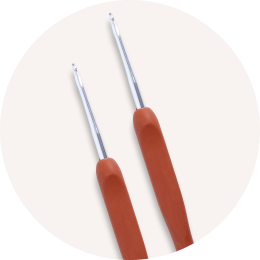
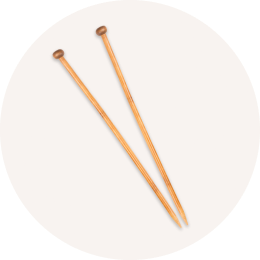
A 5.5 mm aluminium crochet hook is about 15 cm long with one rounded working end and a blunt handle. There is nothing on it that can puncture skin. Knitting needles are a different shape: two shafts, usually 25–35 cm in straight form, each tapering to a point that has to be fine enough to enter a stitch cleanly.
Point sharpness varies more than most parents realise. Nickel-plated metal needles are milled to a fine, almost pen-like tip; bamboo and birch needles in the same 5 mm size have noticeably duller tips and grip the yarn better, which slows a beginner's stitches down in a useful way. For a first pair, wood beats metal on both counts.
The risks that are real versus the ones that are not
- Not a real risk: the hook or needle itself in normal use. Yarn tools are blunt instruments compared with the average kitchen drawer.
- A real risk: the tapestry needle used for weaving in ends. It is 5 cm of steel with a genuine point, and it disappears into sofa cushions.
- A real risk: straight needles left in a project on the floor where a younger sibling or a dog will find them.
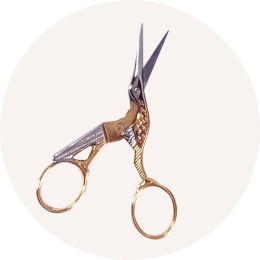
- A quiet risk: scissors. Most teens reach for whatever is nearest rather than a 10 cm folding pair.
The other common mistake at the buying stage is grabbing a bargain-bin hook set. Those sets are usually 0.6 mm to 2.75 mm steel lace hooks intended for thread, and a teenager trying to learn on one will conclude within twenty minutes that they are bad at this. Start at 5.5 mm or 6 mm and nothing smaller.

From the Hooks & Needles shop
Crochet Hooks Organizer
If loose tools scattered around the living room are the actual safety concern, a roll that keeps every hook and the tapestry needle in a labelled slot solves it better than any warning does.
Time to a Finished Object
Crochet builds one stitch at a time, and only one live loop sits on the hook. That single fact is why a 20 cm single-crochet square — dishcloth, coaster, phone pouch — is realistically finishable in two evenings by someone who learned the stitch that morning.
Knitting holds every stitch of the current row live on the needle. Cast on 30 stitches for a garter-stitch scarf in worsted-weight yarn and you have 30 things that can go wrong per row, plus a cast-on edge that most beginners have to attempt three times before it looks even.
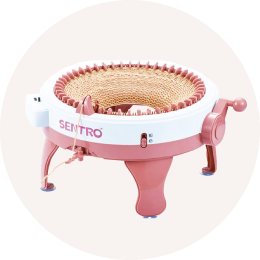
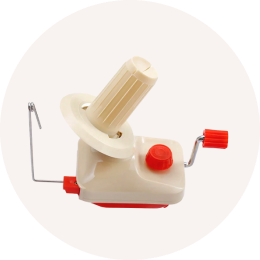
The knitting machine collapses this to about forty minutes for a hat tube. It also skips the learning entirely — the machine forms the stitches, so nobody comes out of it knowing how a knit stitch is built.
| What matters | Crochet hook | Knitting needles | Knitting machine |
|---|---|---|---|
| Live stitches at risk | One loop | Every stitch in the row | None the maker handles |
| First finished item | 1–2 evenings | 1–2 weeks | Under an hour |
| Undoing an error | Pull the yarn, re-hook | Unpick stitch by stitch or lose the row | Unravel and re-crank |
| Skill actually learned | Full stitch formation | Full stitch formation | Tension and finishing only |
| Portable to school | Yes, one tool | Yes, with a stitch stopper | No |
What Happens When It Goes Wrong at 11pm
This dimension decides more first-project outcomes than difficulty does. A teen who hits a mistake they cannot fix will put the bag down, and the bag stays down.
In crochet, recovery is brutally simple. Slide the hook out, pull the working yarn, watch the stitches release one by one, stop when you reach the good row, and put the single loop back on the hook. Nothing else is at stake because nothing else was live.
In knitting, a dropped stitch runs. It ladders down through every row below it, and fixing it properly requires — and this is the joke of it — a small crochet hook to ladder the stitch back up. Ripping back a knitted row means either unpicking stitch by stitch or pulling the needle out and re-seating 30 live loops in the right orientation, which is a genuinely advanced skill.
The craft a teenager sticks with is not the easier one to start, it is the one they can rescue by themselves at midnight without asking an adult.
Two mistakes that cause most abandoned first projects
- Working too tightly. Beginners grip, and tight stitches make the next row physically hard to enter. Going up one hook or needle size fixes what feels like a skill problem.
- Skipping the gauge check entirely. Gauge is how many stitches and rows fit in 10 cm of fabric. For a square dishcloth it does not matter; the moment a teen tries a hat, it decides whether it fits a head.
What a Sixteen-Year-Old Actually Wants to Make
Look at what circulates on the platforms teens actually use, and it is overwhelmingly crochet: amigurumi animals, bucket hats, granny-square cardigans, bag straps, plushie clothes. Those shapes exist in crochet because crochet builds in the round easily and holds a firm, sculptural fabric.
Knitting produces the other half of the list — smooth stocking-stitch sweaters, socks, ribbed beanies with real drape. That fabric is objectively nicer against skin, but it is four to six weeks away for a first-timer, not four days.
Match the tool to the thing they have already pictured. A teen who wants a small crocheted octopus by the weekend and is handed knitting needles will not translate their enthusiasm; they will lose it. The same principle drives everything in finishing a first knitting project without overwhelm — scope the first thing small enough that it ends.
The Recommendation, and Who Should Ignore It
Start a teenager on crochet. One 5.5 mm hook, 100 g of smooth worsted-weight yarn in category 4, in a light solid colour so the stitches are visible, and a 20 cm square as the first project. Chain, single crochet, and how to count rows — that is the entire first session.
Light colour and smooth yarn are not fussy details. Dark yarn hides stitch definition, and fluffy or boucle yarn hides mistakes until they are twelve rows deep and unfixable.
Ignore this and start with knitting if any of these apply
- They have specifically asked to knit because a friend or a school club knits. Social motivation outperforms ergonomics every time.
- They want socks or a fine-gauge sweater and are willing to wait for it.
- They have hand or wrist pain. Knitting spreads effort across both hands; crochet loads one wrist repeatedly.
- They are left-handed and you are a right-handed teacher, in which case read up on why left-handed crocheters and knitters need different tools before the first lesson, because mirroring a crochet demonstration is harder than mirroring a knit stitch.
And if what they actually want is a hat by Sunday with no learning curve attached, a machine like the  48 Needles Knitting Machine with Row Counter will do it — just be clear with yourself that it is a different craft, not a gateway to hand knitting.
Ready to start a project you will actually finish?
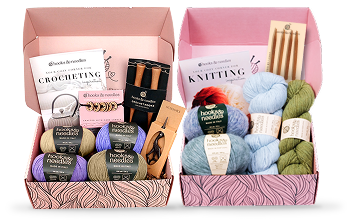
Hooks & Needles delivers a complete yarn project to your door every month — coordinated yarn, the right hooks or needles, and a pattern written to be followed rather than decoded. Pause or cancel whenever you like.
Use LEARN20 for 20% off your first box

Before You Start
Buy one hook, not a set of twelve. A single 5.5 mm hook and one skein costs less than a takeaway and tells you within a fortnight whether this is a real interest or a passing one.
Agree the first project before the yarn arrives, and keep it under 25 cm square. A scarf is the classic trap — 150 cm of the same stitch is a test of endurance, not skill, and it is where most teen projects die.
Do not correct their tension in week one. Uneven stitches are what learning looks like, and a teen who feels supervised will stop working on it when you are in the room. If you are weighing up whether a structured monthly kit is a fair starting point rather than a pile of loose supplies, the honest answer to whether Hooks & Needles works for absolute beginners covers what is and is not included.
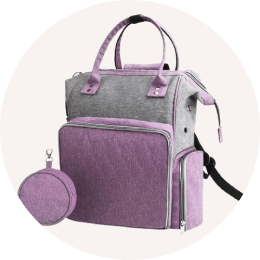
Then leave the bag somewhere visible. Crafts that live in a cupboard stay in the cupboard.
FAQ
My teen already tried crochet and hated it. Should they still avoid knitting?
No — switch. Crochet's one-handed grip and the tight, dense fabric it produces genuinely put some people off, and that dislike does not transfer. Hand them 5 mm bamboo needles and a garter-stitch square, and expect the first week to be slower than crochet was. If the objection was specifically the wrist strain rather than the fabric, knitting is the better fit anyway.
Is a teen crochet kit safe to take to school?
Generally yes for the hook itself, but check the individual school's policy on the scissors and the tapestry needle, which are the parts most likely to be flagged. Swap in a folding yarn cutter and keep the tapestry needle at home until the project needs finishing. For travel further afield, the rules on hooks and needles differ by airline and country.
They want to make a jumper as the first project. Do I redirect them?
Redirect the size, not the ambition. Ask for one 20 cm square in the same yarn and stitch first — it teaches gauge, shows them how many hours 400 square centimetres actually takes, and becomes a pocket or a coaster rather than wasted work. If the square comes back finished and they still want the jumper, they have earned it and you now know their real gauge.