Quick Summary
You have been told that lumpy, uneven stitches mean you are not good yet — and you half believe it. By the end of this you will know exactly when even gauge matters, when deliberate tension changes are the technique itself, and how three working fibre artists use inconsistency to make fabric hold a shape. If you have ever pulled back a wobbly row that actually looked interesting, this is for you.
Every beginner tutorial repeats the same instruction: keep your tension even, and if your stitches wobble, you simply need more practice. That is honest advice for a cardigan. It stops being true the second your fabric is no longer expected to fit a human body.
Consistent gauge is a fit requirement, not a measure of skill. Artists working in fibre change tension mid-row on purpose, mix stitch heights that no pattern would put together, and switch hooks three sizes in a single piece — because a flat, even fabric cannot cup, ruffle, twist or stand up on its own. Here is what they are actually doing, and why the rule you learned first is narrower than it sounded.
Even Gauge Is a Fit Requirement, Not a Skill Grade
Gauge is a prediction tool. It is the number of stitches and rows you get across a measured square — usually 10cm or 4in — and its whole job is letting a designer promise that 96 stitches will become a 48cm chest. Change the gauge and the maths collapses. That is the entire reason patterns nag you about it.
Nothing about that says uneven stitching is bad craft. It says uneven stitching makes size unpredictable, which matters enormously for a sock and not at all for a wall hanging.
The mistake most people make is reading a lumpy first swatch as a verdict on themselves. Usually the cause is mechanical rather than personal: a hook with a different throat depth, a tighter grip after forty minutes, a yarn that grabs. If you want the tooling side of that, the difference between two hooks both stamped 5mm is worth understanding before you blame your hands.
What Hook and Needle Art Does With Tension Instead
Freeform crochet has no gauge, no stitch count and no repeat. Prudence Mapstone, the Australian artist who has spent decades teaching the approach, builds pieces from "scrumbles" — small irregular patches worked outward in whatever stitch the shape asks for, then joined into a larger fabric. The joins are visible. That is the point.
What makes it work is differential tension. A row worked tightly next to a row worked loosely will not lie flat, because the two rows have different lengths along the same edge. The loose section has nowhere to go, so it ruffles. The tight section pulls, so the fabric cups.
Uneven tension is only a mistake when something else has to fit.
Mixing stitch heights on purpose
Stitch height does the same job faster than tension does. A single crochet is roughly half the height of a double crochet, so dropping from one to the other mid-row shortens that section of fabric and forces a curve. Freeform crochet art leans on this constantly — five doubles, two singles, a slip stitch, back to trebles, all in one pass.
If double crochet is the stitch you are least confident placing, this one-minute walkthrough shows the yarn over, the insertion, and both pull-throughs at working speed.
DOUBLE CROCHET FOR COMPLETE BEGINNERS
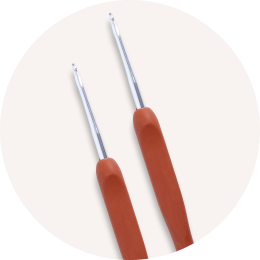
The other lever is the hook itself. Working the same yarn with a 3mm and then a 6mm gives you dense and airy fabric from one ball, which is why freeform workers keep a full range within reach — a set like the
 8 Pcs Purple Crochet Hook Set
covers the usual span without hunting through a drawer mid-piece.
8 Pcs Purple Crochet Hook Set
covers the usual span without hunting through a drawer mid-piece.
The common error here is using one hook for the whole thing and wondering why the piece stays stubbornly flat. Flat is what consistency produces. Shape comes from contrast.
Yarn Bombing Is Sized to an Object, Not a Body
Magda Sayeg started yarn bombing in 2005 by covering a shop door handle in Houston, then scaled up through lamp posts, buses and, eventually, whole vehicles. Olek, working in crochet, wrapped Wall Street's Charging Bull in a full crocheted cover in December 2010. Neither piece needed an even fabric. Both needed a fabric that gripped a rigid object with no give in it.
That reverses everything you know about ease. A sleeve is made slightly larger than the arm. A yarn bomb is made deliberately smaller than the pole, because the fabric has to stretch on and stay under tension, or it slides down and sags within a week.
Where people get the sizing wrong
- Measuring the object and matching it exactly — knitted and crocheted fabric relaxes, and outdoor damp accelerates it.
- Using a loose gauge for speed, which produces fabric with no recovery at all.
- Forgetting the seam allowance for the join that closes the piece around the object.
Acrylic is the standard choice for outdoor textile art techniques, not because it is precious but because it survives rain and sun far better than untreated wool and costs little enough to abandon.
Sculptural Work Needs Fabric That Refuses to Drape
Standing sculpture demands the opposite extreme: gauge so tight the fabric behaves like felt. Take a worsted yarn labelled for a 5mm hook and work it on a 3mm, and you get a stiff, dense fabric that holds a curve without any internal support. It is slow and hard on the hands, and it is how most crocheted vessels and masks keep their walls upright.
Toshiko Horiuchi MacAdam's crocheted playground nets sit at the far end of this — structures children climb inside, where tension is a load-bearing decision rather than an aesthetic one.
Scale changes the tools. Once you move to super bulky or held-double yarn for large forms, standard hooks stop coping, and something like
 Large Crochet Hooks for Chunky Yarn
becomes the practical option for open, airy structural work.
Large Crochet Hooks for Chunky Yarn
becomes the practical option for open, airy structural work.
One habit worth stealing from sculptural workers: keep a written note of hook size and yarn for any section that behaved the way you wanted, taped to the piece itself. Freeform is unrepeatable from memory, and you will want that combination again three weeks later.
Finally, blocking — wetting or steaming finished fabric and pinning it to shape until dry — does something different in art work than in garments. In a jumper it evens stitches out. In sculpture it sets a shape permanently, and heavy-handed blocking will flatten the exact irregularity you spent hours building.
Ready to start a project you will actually finish?
Hooks & Needles delivers a complete yarn project to your door every month — coordinated yarn, the right hooks or needles, and a pattern written to be followed rather than decoded. Pause or cancel whenever you like.
Use LEARN20 for 20% off your first box

What To Do Next
Make one scrumble this week. Chain ten, work back in whatever stitches you feel like, change hook size when the fabric bores you, and stop when it stops being interesting. No measuring.
Then make a gauge swatch for your next garment properly, because both skills are real and they are not in competition. Knowing your even gauge is what lets you leave it deliberately.
If your hooks are old and your tension has quietly drifted without you noticing, checking how wear on hooks and needles changes every stitch is a sensible thing to rule out before you change anything about your hands.
What to remember
- Gauge exists to predict finished dimensions — it is irrelevant when nothing has to fit.
- Loose next to tight makes fabric ruffle or cup; that is how freeform builds shape.
- Changing stitch height mid-row curves fabric faster than changing tension does.
- Yarn bombing pieces are made smaller than the object so they stay taut.
- For sculpture, drop two or three hook sizes below the ball band to get fabric that stands up.
- Block sculptural work lightly — hard blocking erases the irregularity you built.
FAQ
So should I stop bothering with gauge swatches?
No. Anything worn or sized still needs one — sweaters, socks, hats, gloves. The point is that gauge is a tool for controlling dimensions, not a test you pass. Skip it for wall pieces, sculpture and yarn bombing; keep it for anything that has to go around a body.
Do I need to be advanced before trying freeform crochet?
You need chain, slip stitch, single crochet and double crochet. That is genuinely it. Freeform is more forgiving than a fitted pattern because there is no count to lose and no size to miss — the main adjustment is psychological, not technical.
Does any of this apply to knitting, or is it all crochet?
Both, but unevenly. Crochet builds one stitch at a time in any direction, which suits freeform and sculpture far better. Knitting achieves comparable effects through short rows, dropped stitches, held-double yarn and heavy felting — it takes more planning and less improvisation.
Is yarn bombing legal?
It depends entirely on where you are and what you attach it to. Private property with permission is straightforward. Street furniture usually is not, and pieces get removed. Many councils and galleries now commission installations directly, which is the simplest route if you want the work to stay up.
What yarn should I use for sculptural pieces?
Cotton and acrylic hold a shape better than soft wool because they have less spring and less memory. For pieces you intend to felt, use non-superwash wool — superwash is treated specifically so it will not felt, which is the opposite of what you want here.