You have three ways to size a knitted book sleeve, and only one of them survives contact with your actual bookshelf. You can cast on the number a free pattern gives you and hope your book matches the designer's paperback. You can eyeball a fixed pattern up or down by a few stitches. Or you can measure the book, swatch, and calculate a cast-on that fits it exactly.
The third option sounds like more work and takes about six minutes, most of which is swatching you should be doing anyway. Below is the formula, a worked example for a paperback, a hardback and an e-reader, the full free pattern written in garter stitch, and a clear statement of who should ignore all of it and just knit the fixed size.
Fit Is Decided by the Book, Not the Pattern
A mass-market paperback is roughly 4.25 inches wide, 7 inches tall and an inch thick, which is the size almost every published sleeve pattern assumes without saying so. A trade paperback is an inch and a half wider. A hardback novel is wider still and does not squash. An e-reader is thin, rigid and expensive to drop.
Those four objects need four different stitch counts, and the difference is not trivial — at a worsted-weight gauge, the gap between a mass-market paperback and a hardback is around ten stitches. Ten stitches is the difference between a sleeve that grips and one that slides off in your bag.
Compressibility is the second thing that changes the numbers. A paperback gives when you squeeze it, so you can knit the sleeve smaller than the book and let the fabric hug. A hardback has board covers that do not yield by a millimetre, and an e-reader should never be squeezed at all.
Construction changes the maths too, since a tube worked in the round needs the full circumference while a folded rectangle needs half of it. If you have not settled that question yet, the comparison of flat and seamed, in-the-round and folded book sleeve construction is the place to decide before you cast on. The formula below is written for the folded rectangle, and I note the adjustment for a tube.
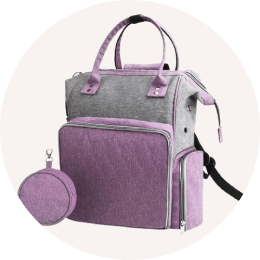
One more thing worth sizing for: where the sleeve lives. A book that rides in the bottom of a  Multifunctional Knitting Tote Bag alongside needles and a ball of yarn wants a snugger sleeve than one that sits on a nightstand.
Gauge Is What Turns a Book Sleeve Knitting Pattern Into Your Numbers
Gauge is simply how many stitches and rows you get per inch in a given yarn, needle and stitch pattern. Every fixed-size pattern is really a gauge statement in disguise: it says cast on 24 stitches because the designer got 4.5 stitches to the inch. Change either half of that and the size changes with it.
The three measurements to take
- W — the width of the front cover, measured across the closed book from spine to fore-edge.
- H — the height of the cover, top to bottom.
- T — the thickness of the whole closed book, covers included.
The cast-on formula
Cast-on stitches = (W + T) × stitches per inch × ease factor, rounded to an even number. Use an ease factor of 0.9 for a paperback, 0.95 for a hardback, and 0.95 for an e-reader or tablet. For a sleeve worked in the round, double the result and join.
Total rows = ((H + 0.4) × 2 + T) × rows per inch. The 0.4 inch keeps the book from peeking out of the top, and adding T once gives the fabric enough length to wrap around the bottom edge instead of straining across it.
At 4.5 stitches and 9 rows per inch in garter stitch — a typical worsted-weight fabric on 4.5 mm needles — a mass-market paperback comes out at 22 stitches and 142 rows. A 6-inch-wide hardback that is 1.5 inches thick comes out at 32 stitches. A standard Kindle lands at 22 stitches but only 126 rows, because it is shorter than the paperback and barely thicker than a pencil.
Do I really need to block a swatch for something this small?
Yes, if the finished sleeve will ever be washed. Garter stitch in wool typically relaxes wider and shorter after a soak, and a swatch measured dry off the needles can overstate your stitches per inch by a quarter of a stitch — which is a full inch of width across a sleeve.
The free pattern
Yarn: any weight 4 worsted or aran, roughly 60–90 g depending on book size. Needles: whatever gives you a firm garter fabric, usually 4 to 4.5 mm. Notions: darning needle for seaming.
- Swatch in garter stitch over at least 4 inches, wash and dry it, then divide your stitch count by the measured width to get stitches per inch.
- Cast on your calculated number of stitches using a long-tail cast-on.
- Knit every row until the piece measures your calculated total length. Garter stitch is reversible, does not curl, and stretches to grip the book.
- Bind off loosely in knit. A tight bind-off is the single most common reason a finished sleeve will not accept its book.
- Fold the rectangle in half widthwise, right sides out, and mattress-stitch the two side edges closed.
Rather than committing that stitch count to memory, write it on the pattern printout with the book's name next to it. Even better, wrap the blocked swatch around the closed book and count how many stitches it takes to reach halfway around — that is your cast-on number, arrived at with no arithmetic. If the abbreviations in written instructions still slow you down, the walkthrough on reading a knitting pattern without drowning in abbreviations is worth twenty minutes.
Where Sizing Goes Wrong, and the Fix for Each
Measuring the page block instead of the cover. Covers overhang the pages on most paperbacks by an eighth of an inch and on hardbacks by considerably more. Fix: measure the closed book across the outside of the covers, every time.
Leaving thickness out of the width calculation. A sleeve sized to cover width alone will go over the book and then refuse to close around the spine. Fix: the width in the formula is W + T, not W.
Measuring gauge over one inch. A one-inch measurement carries an error of half a stitch, which multiplies into two or three stitches across the sleeve. Fix: count over four inches and divide.
Applying paperback negative ease to a rigid book. A hardback or an e-reader has nothing to give back, so the sleeve simply will not fit. Fix: ease factor 0.95, and if the book is a treasured one, use 1.0 and let it slide in easily.
Forgetting the fold allowance in the length. Knit to exactly twice the book height and the bottom fold pulls the top opening down until the book sticks out. Fix: add T once to the total length, as the row formula does.
What I'd Knit, and Who Should Skip the Formula
Measure and calculate. It costs six minutes, it works for the trade paperback and the hardback and the library book you have not bought yet, and it means you never knit a second sleeve because the first one was two stitches tight. That is the recommendation, and I would give it to a knitter on their third project as readily as their thirtieth.
Ignore it in three situations. If you are knitting a gift for someone whose shelf you have never seen, a fixed mass-market size is the safer guess, because a slightly loose sleeve still works and a tight one does not. If you are knitting in a chunky yarn at two and a half stitches per inch, the rounding error swallows the precision and you may as well work to a tested size.
And if the point of the evening is to knit rather than to measure, a fixed pattern is a perfectly good evening. Collections like the  10 Knitting Patterns exist so you can cast on without doing sums first.
The stitch you choose matters almost as much as the count, and the case for garter stitch over stockinette in a book sleeve is about curl and grip rather than looks. Substitute a different stitch pattern and you must re-swatch, because ribbing and seed stitch have very different stitches per inch at identical needle size.
Ready to start a project you will actually finish?
Hooks & Needles delivers a complete yarn project to your door every month — coordinated yarn, the right hooks or needles, and a pattern written to be followed rather than decoded. Pause or cancel whenever you like.
Use LEARN20 for 20% off your first box

Closing Thoughts
A fixed cast-on number is someone else's book, measured once, years ago. Your gauge and your book are the two facts that decide the size, and the formula is short enough to keep on a card in your notions tin.
Swatch, measure the closed covers, add thickness to width, multiply, round to an even number. Then knit the whole thing in garter stitch and bind off loosely.
The first sleeve you make this way takes longer than casting on 24 and hoping. Every one after that fits.
FAQ
Does the formula still work in fingering or DK yarn?
It works, but adjust the ease factor upward. Thin fabric stretches more readily than worsted garter, so a 0.9 factor in fingering weight can give a sleeve that grips hard enough to mark a soft cover — use 0.95 for paperbacks and 1.0 for hardbacks at that gauge.
Can I use the same maths for a crochet book cover?
The measuring and the width formula transfer directly, but the ease factor does not. Crochet fabric in single or double crochet stretches far less than garter stitch, so work at 1.0 with no negative ease, and swatch in the exact stitch you plan to use because single and double crochet give very different stitches per inch on the same hook.
What if I want one sleeve to fit several different books?
Size it to the widest and thickest book you own, use an ease factor of 1.0, then add a two-stitch garter gusset at each side seam so the fabric can collapse around thinner books. This is the one case where the calculated snug fit is the wrong goal.