The ring is still in its packet and you have already decided you will knit worse with it on. That is the usual hesitation: the yarn runs through a loop you cannot feel, your left index finger forgets what it was doing, and forty rows later you have a swatch that measures nothing like the last one. One of those fears is founded — feeding the yarn differently does move gauge — but only in the situations where the ring is doing real work, and that list is shorter than the packaging suggests.
We knitted four swatches to find out where the line sits: 100g of DK yarn, 4mm needles, one pair of hands, two evenings. Two in plain stockinette, one bare-handed and one with a ring, then two in a simple two-colour stranded pattern under identical conditions. By the end you will have the measured numbers, the finger placement that stops the yarn slipping out mid-row, and a straight answer on whether to skip buying one.
Setting Up So the Two Swatches Are Actually Comparable
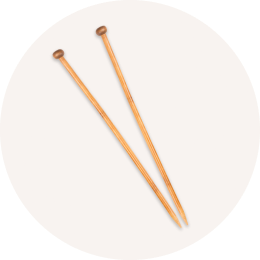
Use one yarn, one dye lot, one needle for all four swatches. The whole test collapses if the second swatch is a different fibre — a woollen-spun yarn and a smooth plied yarn will give you a half-stitch difference per 10cm on their own, and you will credit that difference to the ring. We used a single 100g ball of DK-weight yarn on 4mm bamboo needles throughout.
Cast on 32 stitches for each swatch. That gives you roughly 14cm of fabric at DK gauge, which leaves a proper 10cm measuring window once you ignore the three edge stitches on each side that always misbehave.
Knit both swatches in the same session if you can. Tension drifts with mood, hand temperature and how tired you are, and a swatch knitted on Sunday morning is not a fair partner for one knitted on Thursday night after work. If you need to split it across evenings, alternate: bare hands, ring, ring, bare hands.
Check the ball band before you start and note the gauge the manufacturer expects. If your bare-hand swatch lands three stitches away from it, that is worth knowing before you start blaming a ring — the yarn label guide covering weight categories and stated gauge explains what those numbers on the band are actually promising.
Swatch One: The Bare-Hand Baseline
Knit 40 rows of stockinette without paying attention to it. This is the hardest instruction in the whole test and the one people get wrong. A swatch knitted with your best concentration is not the fabric your jumper will be made of, because you will not knit the body of a jumper while staring at every stitch.
Put something on that you have already seen, and knit. Our baseline swatch came out at 22 stitches and 30 rows to 10cm after blocking, measured in three separate windows with a stitch gauge.
Should I swatch flat if my project is knitted in the round?
Flat stockinette and stockinette in the round rarely match, because purl rows sit slightly differently to knit rows for most people. For this comparison it does not matter — both swatches have the same bias — but for an actual garment, swatch the way you will knit it.
Note how your yarn is currently controlled while you knit. Most knitters run the working yarn over the index finger and around the little finger, and the little finger is where the real braking happens. That detail matters in the next stage, because it is the habit most likely to fight the ring.
Putting the Ring On Without Fighting It
A yarn tension ring is a loop worn on a finger of your yarn-holding hand, with the working yarn threaded through it so the yarn is fed at a fixed distance from the needle instead of at whatever distance your finger happens to be holding. A knitting thimble is the same idea with two or more separate eyes, made for carrying two colours at once. Neither adds tension by itself — they make the feed position consistent, which is a different thing.
Wear it on the index finger of the hand that carries the yarn, loop facing up and slightly towards the needle tips. Thread the yarn through the loop before you cast on, not after, and let the ring sit at the middle knuckle rather than the base of the finger.

From the Hooks & Needles shop
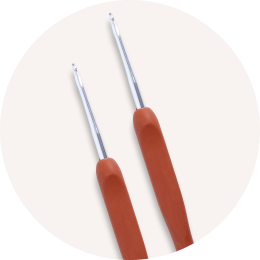
Yarn Tension Control Ring
The adjustable coil is what makes this one usable across finger sizes — a ring that spins loose on your finger mid-row will undo the consistency you bought it for.
The common mistake here is running the yarn through the ring while still wrapping it around your little finger at full strength. You now have two brakes on one strand and the fabric comes out noticeably tighter — which reads as "the ring changed my gauge" when it was really your pinky doing what it always did. Loosen the little-finger wrap to a light drape, or drop it entirely.
Our stockinette-with-a-ring swatch measured 22 stitches and 29.5 rows to 10cm. Against a bare-hand 22 and 30, that half-row difference is inside measuring error. For plain single-colour knitting, the ring did nothing we could put a number on.
Want the yarn, the pattern and the guidance in one box?
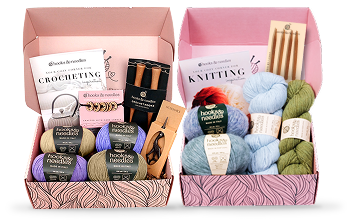
Each Hooks & Needles box arrives with the yarn, the tools and an exclusive pattern already matched to each other, plus instructions that do not skip the step you are stuck on. Nothing to source, nothing to substitute.
Use LEARN20 for 20% off your first box

Where Tension Ring Knitting Earns Its Place: Two Colours at Once
The stranded swatches are where the numbers separated. We worked a simple eight-stitch repeat over 40 rows, carrying both colours across the back of the fabric, bare-handed first and then with both strands running through separate channels of the ring.
Bare-handed, the three measuring windows gave 19.5, 21 and 21.5 stitches to 10cm — a two-stitch spread across a swatch 14cm wide. With the ring, the same three windows read 20.5, 21 and 21.5. The spread halved, and the puckering at the tight end of the swatch went with it.
Why the ring helps here and not in stockinette
Carrying two strands means your finger is constantly renegotiating which one is on top and how far each has to travel. That renegotiation is the source of the variance — the strand you pick up second gets pulled a fraction harder. Fixing both strands at a set distance takes that decision away from your finger.
One thing worth doing before you commit to a ring for a colourwork project: thread the two colours in the order you want them to stay. The strand in the lower eye travels slightly further, which makes it the dominant colour, and its stitches sit marginally larger. Swapping the strands mid-motif changes which colour looks bolder, and you will see it. If your floats are the real problem rather than your feed position, managing yarn tension in Fair Isle knitting covers the float-spreading habits that no tool replaces.
A smooth, well-plied yarn makes all of this easier to read, because the stitch definition shows you where the fabric is pulling —  Enduring Elegance Yarn holds a crisp stitch for exactly this reason.
Blocking and Measuring So the Numbers Mean Something
Measure nothing before blocking. An unblocked stranded swatch reads two stitches tighter than it will after a soak, and you will conclude the ring made no difference when the fabric simply had not relaxed yet.
Soak each swatch in lukewarm water for 20 minutes, press the water out in a towel without wringing, and pin them flat to shape — flat, not stretched. Leave them 24 hours. Pinning a stranded swatch out to its "correct" width is cheating; it hides the exact puckering you are trying to measure.
Count over 10cm in three places on each swatch, never at the edges. Write the three numbers down rather than averaging them in your head, because the spread between them is the whole result — a swatch averaging 21 stitches is not the same fabric as one that reads 21 everywhere.
Who Should Skip Buying One
Skip it if
- You knit single-colour fabric almost exclusively. Our stockinette numbers were identical either way.
- Your current hand hold is comfortable and your fabric is even. A ring solves a problem you do not have.
- You have sore or swollen finger joints. A fixed metal loop at the knuckle can press, and a coiled adjustable style is the only version worth trying.
Buy one if
- You are doing stranded colourwork and your floats alternate between tight and slack.
- You carry two or three strands for any reason, including holding a lace yarn together with a main yarn.
- You are moving from throwing to continental and your yarn keeps escaping your index finger entirely.
Give yourself a full evening before you judge it. The first twenty rows feel clumsy for almost everyone, and the fabric from those rows is not evidence of anything.
Closing Thoughts
The honest result is narrow: no measurable gain in plain stockinette, a halved tension spread in two-colour stranded work. A ring is a colourwork tool that happens to be sold as a general one.
Knit the four swatches yourself if you are undecided. Two evenings and one ball of yarn will tell you more about your own hands than any test we run, because the variance a ring removes is variance you personally introduce — and some knitters simply do not introduce much of it.
Either way, keep the stranded swatch. Pinned flat with its three measurements written on a tag, it becomes the reference you check against the next time a colourwork yoke starts puckering.
FAQ
My yarn keeps slipping out of the ring mid-row. What am I doing wrong?
The ring has almost certainly rotated so the loop faces sideways instead of towards the needle tips. Adjust the coil so it sits snugly at the middle knuckle, and check the loop orientation every few rows until the fit is right — a ring that spins freely will keep releasing the yarn.
Which finger should the ring go on?
The index finger of whichever hand carries your yarn — left for continental knitters, right for throwers. Some people prefer the middle finger for a longer feed distance, which gives slightly looser fabric. Pick one and stay with it for the whole project.
Do I still wrap the yarn around my little finger?
Not at the same strength. If you keep a firm pinky wrap and add the ring, you are braking the yarn twice and your fabric will tighten. Let the yarn rest lightly against the little finger, or drop the wrap entirely for a few rows and see how the fabric reads.
My stranded section is still tighter than my plain knitting even with the ring. Is that normal?
Yes — stranded fabric is nearly always denser than single-colour fabric in the same yarn, because the floats on the back add bulk and pull. The ring evens out the variation within the colourwork, it does not make colourwork match stockinette. Size your project from a stranded swatch, never a plain one.