Short answer
- A needle size is the diameter of the shaft in millimetres — US and UK numbers are labels layered on top of that measurement, and UK numbers run in the opposite direction to US ones.
- US 8 equals 5.0 mm and UK 6; US 6 equals 4.0 mm and UK 8. The metric figure is the only one that means the same thing in every country.
- Same-labelled needles from different brands measured between 4.87 mm and 5.12 mm on our bench — a 0.25 mm spread, enough to shift a sweater by several centimetres.
- Swatch on the exact needle you will knit the garment with, then check that needle with a needle gauge and write the real millimetre figure in your project notes.
You have the yarn wound, the pattern printed, and a pack of needles that says US 8 on the label. The hesitation is reasonable: you have heard that gauge decides whether the finished thing fits, and you are not sure whether your needles are the ones the designer meant. That worry is half founded and half not. The chart itself is reliable — US 8 really is 5.0 mm, and nobody is going to surprise you there.
What is genuinely unreliable is the needle in your hand matching the number stamped on it. Manufacturing tolerance, worn plating, and a few brands that round generously mean two needles labelled the same size can differ by a quarter of a millimetre. That sounds like nothing. Over a sweater body it is not nothing, and this walkthrough moves through the stages of a project in the order they happen, so you catch it before you cast on rather than after the armholes.
What Knitting Needle Sizes Actually Measure
The number refers to the diameter of the needle shaft — the straight working portion behind the taper, not the point and not the cable. That diameter sets how large a loop of yarn wraps around it, which is why a fraction of a millimetre compounds across hundreds of stitches. Length has nothing to do with sizing. A 25 cm and a 35 cm needle marked 4.0 mm make identical stitches.
US sizing counts upward as needles get thicker: 0 is fine, 15 is chunky. UK and old Canadian sizing counts downward, so a UK 14 is a thin 2.0 mm and a UK 000 is a fat 10.0 mm. Metric just states the diameter. If you learn one system, learn that one.
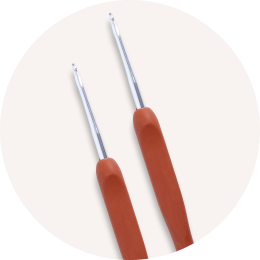
Crochet hooks use a parallel but separate system, and the US hook letters do not map onto needle numbers at all. If you crochet as well as knit, keep the two charts apart in your head. An H hook is 5.0 mm, which happens to match a US 8 needle, and that coincidence has confused more than one person mid-project.
The US, UK and Metric Conversion Chart
Here is the standard conversion, split at the point where most garment knitting starts. Sizes below 3.25 mm are sock, lace and fine-baby territory.
- 2.0 mm — US 0 · UK 14
- 2.25 mm — US 1 · UK 13
- 2.75 mm — US 2 · UK 12
- 3.0 mm — no US equivalent · UK 11
- 3.25 mm — US 3 · UK 10
- 3.5 mm — US 4 · no UK equivalent
- 3.75 mm — US 5 · UK 9
From 4.0 mm upward you are into the range that covers DK, worsted, aran and chunky yarns — the sizes most patterns in a subscription box or a magazine will call for.
- 4.0 mm — US 6 · UK 8
- 4.5 mm — US 7 · UK 7
- 5.0 mm — US 8 · UK 6
- 5.5 mm — US 9 · UK 5
- 6.0 mm — US 10 · UK 4
- 6.5 mm — US 10½ · UK 3
- 7.0 mm — no US equivalent · UK 2
- 8.0 mm — US 11 · UK 0
- 9.0 mm — US 13 · UK 00
- 10.0 mm — US 15 · UK 000
- 12.0 mm — US 17
- 15.0 mm — US 19
- 19.0 mm — US 35
Notice the gaps. There is no US number for 3.0 mm or 7.0 mm, and no UK number for 3.5 mm, which is why some conversion charts quietly round those to the nearest neighbour. That rounding is the first place a knitting needle size chart stops being exact.
Measure the Needles You Already Own
A needle gauge costs very little and settles the question in ten seconds. It is a flat plate with drilled holes marked in millimetres; you slide the needle shaft through until you find the hole it passes cleanly with no wobble. Use the shaft, never the tip, and never the join on an interchangeable.
We measured five needles all labelled 5.0 mm, from five different makers, sitting in one studio drawer. They read 4.87, 4.94, 5.00, 5.06 and 5.12 mm. That is a 0.25 mm spread across needles a pattern would treat as identical.
Does the material change the size, or just the feel?
Material does not change the stated diameter, but it changes the tension you knit at. Bamboo and wood grip the yarn and tend to produce slightly tighter, more even fabric, while polished metal lets stitches slide and many knitters loosen on it. Two needles measuring exactly 5.00 mm in different materials can still give you different gauge.
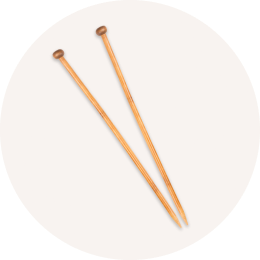
Wooden and bamboo needles also shift over time. Sanding at the tip, compression from years of use, and even humidity move them by hundredths, and a well-loved bamboo 4.0 mm can read closer to 3.9 mm. A full graduated set such as these  36 Pcs Bamboo Knitting Needles makes it easy to try a half-size up or down without waiting on a delivery mid-project.
Swatch on the Exact Needle You Will Use
Gauge is the number of stitches and rows in a measured 10 cm square of fabric, and it is the only thing that connects a pattern's numbers to your body. The swatch has to be knitted on the specific needle that will knit the garment — not a spare of the same nominal size, and not a straight when the project is in the round.
- Cast on wide. Aim for at least 15 cm of fabric so you can measure in the middle, away from the curling edges that distort every reading.
- Knit in the pattern stitch. Stocking stitch gauge tells you nothing about a cabled or ribbed fabric, which pulls in at a different rate entirely.
- Block it exactly as you will block the garment. Wet or steam, then dry flat — many yarns relax by a full stitch per 10 cm once wet, and that stitch is the whole difference.
- Measure over 10 cm with a ruler, not a tape. Soft tapes stretch; count the stitches between two pins rather than eyeballing the edge.
What goes wrong here
The usual failure is a swatch that is too small to measure honestly. A 10 cm square gives you 10 cm of measuring room, which means the curling edge is inside the count and your result is a guess. Cast on more than feels necessary.
The second failure is skipping the block. Superwash merino and cotton both change noticeably when wet, and an unblocked swatch flatters you into thinking you are on gauge. Then the finished sweater grows two sizes in its first wash.
A quick trick worth adopting: knit your swatch with a strand of contrast yarn threaded through to mark which needle you used — one purl bump for each millimetre, or a simple eyelet count. Six months later, when the swatch surfaces in a bag, you will still know what made it.
Picking a Starting Size for Your Yarn
The ball band range is a suggestion from the spinner, not an instruction, and it usually covers two or three sizes. It tells you the band of sizes where that yarn behaves like the fabric it was designed to make. Starting anywhere in that range is sensible; starting outside it means you want a deliberately dense or deliberately airy fabric.
For what size needles for worsted yarn — category 4, the weight most American patterns default to — the usual starting point is 4.5 to 5.5 mm, with 5.0 mm (US 8) as the standard first attempt. DK sits around 4.0 mm, aran around 5.5 mm, and 4-ply or fingering around 3.25 mm for garments and 2.25 to 2.5 mm for hard-wearing socks.
What goes wrong here
Knitters treat the band size as the answer and skip the swatch entirely, which works until the pattern's gauge and the band's assumption disagree. Designers often deliberately go a size down for structure or a size up for drape. Follow the pattern's gauge, not the band.
The other mistake is changing yarn weight without changing needles. Substituting an aran for the worsted a pattern specifies and keeping the same 5.0 mm needle produces a stiff, dense fabric that has none of the intended movement — and eats more yarn than you bought. If you want the reasoning behind how a pattern's needle and gauge notes get written in the first place, our account of how Hooks & Needles is tightening its pattern writing and testing covers what those numbers are meant to guarantee.
Changing Size Without Losing the Project
If your swatch has too many stitches per 10 cm, your fabric is tighter than the pattern wants, so go up a needle size. Too few stitches means go down. One size shifts most worsted-weight gauges by roughly half a stitch per 10 cm, which is often exactly the correction you need.
Half sizes matter more than people expect. Between 5.0 mm and 5.5 mm sits nothing in the US system, but plenty of European brands make a 5.25 mm, and that is frequently the size that lands you on gauge when one jump overshoots and none undershoots.
When you pause to reswatch, park the live stitches properly rather than letting them slide. A set of  Knitting Needles Point Protectors 6pcs keeps a half-finished sleeve on its needles for a week without losing a row, which is the difference between resuming and reknitting.
Record the real measured size in your notes alongside the yarn, the gauge you achieved, and whether you blocked before measuring. That single line is what stops a project becoming the lopsided square that sits in a bag for a year, because you can always pick up where the numbers left off.
Ready to start a project you will actually finish?
Hooks & Needles delivers a complete yarn project to your door every month — coordinated yarn, the right hooks or needles, and a pattern written to be followed rather than decoded. Pause or cancel whenever you like.
Use LEARN20 for 20% off your first box

Where To Go From Here
Measure the needles in the size you use most often, today, before your next cast-on. Most people find one or two that sit noticeably off their label, and knowing which ones those are removes a whole category of mystery from future projects.
Then treat the chart as what it is: a translation layer between three numbering systems, accurate to the standard and silent about your particular needle. It gets you to the right shelf. Your gauge swatch gets you to the right size.
The habit worth building is small. Measure, swatch, block, write it down — four steps that take an evening and save a garment.
FAQ
My swatch is on gauge for stitches but not rows. Do I need to reswatch?
Usually not. Stitch gauge controls width and fit, so it matters most; row gauge controls length, which most patterns let you adjust by knitting to a measurement rather than a row count. Check whether your pattern shapes by rows — set-in sleeve caps and shaped yokes do — and if it does, try a different needle material before changing size, since row gauge often responds to that alone.
The pattern says US 8 but my needles are marked 5 mm. Are they the same thing?
Yes, US 8 and 5.0 mm are the same size in the standard conversion. If your needle is marked 5 mm with no US number, it was made for a metric market and will behave the same as a US 8 of identical diameter. Verify it on a needle gauge anyway, because the label is a claim rather than a measurement.
I switched from straights to circulars halfway through and the fabric changed. Why?
Two things change at once: the material and tip shape are often different between your straights and your circular, and knitting in the round means every row is a knit row rather than alternating knit and purl. Most knitters purl slightly looser than they knit, so working in the round tightens gauge for them. Swatch in the round if the project is in the round.