Measure three things on the book itself — cover width, cover height, and thickness at the spine — then multiply (width + thickness) by your stitches per centimetre. That number is your cast-on for a folded, side-seamed sleeve, and it fits because it was built from your book and your gauge rather than from an average paperback someone owned in 2019.
Below is the full free pattern written that way: the measurements to take, the formula to convert them, a worked example with real numbers, and the ribbed cuff that keeps the opening snug so the book does not slide out in your bag. You will also get the adjustments for hardbacks, chunky paperbacks and e-readers, and the five sizing mistakes that produce a sleeve which is technically finished and practically useless.
The Free Knit Book Sleeve Pattern, Sized to Your Book
Start with the book, not the yarn. Lay it closed on a table and take three measurements in centimetres: the width of the front cover from spine to fore-edge (W), the height of the cover from top to bottom (H), and the thickness of the closed book at the spine (T). Write them down. Those three numbers do all the work from here.
Next, knit a swatch in the stitch you actually intend to use and block it. Gauge is the number of stitches and rows in a given measurement of fabric — usually 10 cm — and it shifts with yarn, needle size, stitch pattern and how tightly you hold the yarn. A swatch of 20 stitches by 30 rows is enough to measure honestly.
The formula
- Stitches per cm = your blocked swatch stitch count ÷ its width in cm.
- Flat panel width = W + T. A tube that wraps a rectangle needs a perimeter of 2W + 2T, and a flattened tube is half its perimeter.
- Cast-on stitches (S) = (W + T) × stitches per cm, rounded to the nearest multiple of 4 so the k2, p2 rib works out.
- Total knitted length (L) = 2 × (H + 1.5 cm). The extra 1.5 cm sinks the book below the opening.
My number landed exactly between two multiples of four — round up or down?
Round down. Knitted fabric stretches and a sleeve wants to grip, so the smaller count gives you a snugger fit that relaxes into shape after a week of use. Round up only if you are working in cotton or a dense non-stretchy blend, which will not recover the way wool does.
Worked example
A trade paperback measuring 13 cm wide, 20 cm tall and 3 cm thick, knitted in garter stitch at 18 stitches per 10 cm, gives a flat width of 16 cm. At 1.8 stitches per cm that is 28.8 stitches, rounded to 28. Total length is 2 × 21.5 cm, so 43 cm.
Instructions
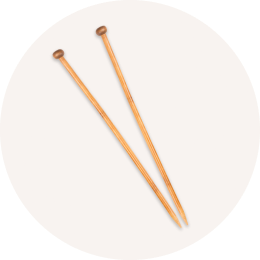
You will need roughly 100 g of medium (weight 4) worsted or aran yarn, 4.5 mm (US 7) needles, one needle a size smaller for the rib, and a tapestry needle. This is a single-layer sleeve — there is no padding or lining in this version, and I will come back to that later.
- With the smaller needles, cast on S stitches and work k2, p2 rib for 3 cm.
- Change to the main needles and work garter stitch (knit every row) until the piece measures L − 3 cm from the cast-on edge.
- Change back to the smaller needles, work k2, p2 rib for 3 cm, and bind off in rib.
- Fold the rectangle in half so the two ribbed edges meet at the top. The fold is your base — no bottom seam to bulk out the spine end.
- Mattress-stitch both side edges, weave in your ends, and block lightly over the closed book.
Garter stitch is doing a specific job here: it lies flat, grips, and hides uneven tension in a way stockinette will not. If you want the reasoning behind that choice rather than taking my word for it, the case for garter stitch over stockinette in a knitted book sleeve goes into the curl and the friction in detail.
What Changes for Hardbacks, Chunky Paperbacks and E-Readers
The formula holds for all of them. What changes is the thickness value and how much give the object has, and those two things decide whether your sleeve slides on easily or fights you at the corners.
A book sleeve fits or it does not, and the number that decides it is almost always the spine thickness nobody bothered to measure.
Hardbacks
Hardback boards do not compress, so a sleeve knitted with negative ease will not squeeze on — it will jam at the corners and stretch the fabric permanently at four points. Use the full W + T with no reduction, and consider adding 0.5 cm to the flat width if your yarn is dense or your fabric came out stiff.
Chunky paperbacks and doorstop novels
A 5 cm thick paperback throws off anyone working from a fixed-size pattern, because the thickness has grown while the cover width stayed the same. Run it through the same formula and you get a wider panel that looks wrong flat and looks right filled. Trust the maths over your eye here.
E-readers
Kindles, Kobos and tablets are thin, rigid and smooth, so a kindle sleeve knitting pattern based on this formula needs two tweaks. Measure the device with its case on if it lives in one, and reduce the length allowance from 1.5 cm to 1 cm — there is no book block to sink. Rigid objects also slip more, so the ribbed cuff matters more, not less.
If you are still deciding whether to work flat and seam, work in the round, or fold as this pattern does, the comparison of flat and seamed versus in the round versus folded construction lays out what each method costs you in finishing time.
Want the yarn, the pattern and the guidance in one box?
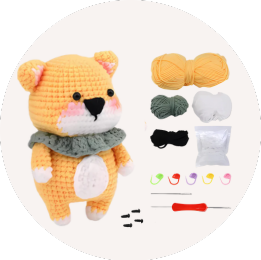
Each Hooks & Needles box arrives with the yarn, the tools and an exclusive pattern already matched to each other, plus instructions that do not skip the step you are stuck on. Nothing to source, nothing to substitute.
Use LEARN20 for 20% off your first box

The Ribbed Cuff That Stops the Sleeve Gaping
Every sleeve that has ever spat a book out into the bottom of a tote had the same problem: the opening was exactly as wide as the body. Knitted fabric under the weight of a book relaxes outward, the opening widens, and the book starts travelling. The cuff is the fix, and it costs you six centimetres of knitting.
The k2, p2 rib at both ends of the rectangle pulls in because the purl columns recede behind the knit columns, so the same stitch count occupies less width. Working those 3 cm on a needle one size smaller tightens it further. The effect you want is an opening that measures 1 to 2 cm narrower than the body when relaxed.
That is enough resistance to hold a book upside down. Not enough to make the sleeve awkward to load.
If your rib is not pulling in
- Drop two needle sizes instead of one. Loose knitters often need the bigger jump.
- Switch to k1, p1 rib. Single rib draws in harder than k2, p2 in most yarns.
- Choose a yarn with some wool in it. Cotton and bamboo have very little memory, so ribbing in them behaves more like plain fabric.

From the Hooks & Needles shop
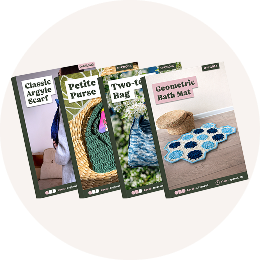
Cozy Home Collection: 8 Crochet & Knit Patterns
If sizing fabric to grip an object is the part you enjoyed, this set of eight knit and crochet home patterns works the same way on mugs, pots and small household things.
Five Mistakes That Ruin the Fit
Measuring the cover but not the spine. A sleeve cast on from cover width alone comes out roughly one thickness too narrow, which is usually 2 to 4 cm of missing fabric. The fix: always add T to W before you multiply, even for a slim book.
Swatching in stockinette and knitting in garter. Garter stitch is wider per stitch and dramatically shorter per row than stockinette at the same needle size, so the panel comes out the wrong shape in both directions. The fix: swatch in the exact stitch pattern you will use.
Measuring the swatch unblocked. Blocking — wetting and drying the fabric to set the stitches — can change stitch gauge by half a stitch per centimetre, which on a 16 cm panel is eight stitches. The fix: block the swatch and treat it the way you will treat the finished sleeve.
Adding ease to be safe. Positive ease in a knitted sleeve does not produce a comfortable fit; it produces a bag the book falls out of. The fix: aim for zero ease in wool and 0.5 cm positive ease only for rigid hardbacks or dense non-stretch yarns.
Ignoring row gauge and knitting to a stitch count instead. Rows control the height, and garter row gauge varies wildly between knitters, so a row-count instruction from someone else's hands will give you a short sleeve. The fix: knit to the measurement L, tape measure in hand, not to a number of rows.
Most of these are gauge problems wearing a fit-problem costume, which is why the gauge formula behind fixed-size versus measured sleeves is worth reading before you cast on a second one.
Where To Go From Here
Cast on for the book you are actually reading right now, not a hypothetical one. Take the three measurements, block one swatch, do the two sums, and you will have a sleeve that grips by tomorrow evening. Keep the numbers written inside the pattern — next time you only need a fresh swatch if you change yarn.
For a padded book sleeve pattern, the honest answer is that this single-layer knit does not pad anything. Add a layer of fleece or quilted cotton cut to the flat panel dimensions and slip-stitch it in before seaming, or knit the panel to double the length and fold it into a lined tube. Both work; both add bulk you should account for by going up half a centimetre in flat width.
Once you have used the formula once, it transfers. The same wrap-and-grip logic sizes a mug cosy, a notebook cover, or the  Teapot Cozy Knitting Pattern, where fitting an awkward shape is the whole exercise.
FAQ
Can I crochet this book cozy instead of knitting it?
Yes, and the measuring stays identical — W + T still gives you the flat panel width. Only the conversion changes: multiply by your crochet stitches per centimetre, worked in single crochet for a dense fabric, and swap the k2, p2 cuff for a few rounds of front-post and back-post double crochet ribbing to draw in the opening.
How much yarn does a knitted book sleeve use?
A trade paperback sleeve in worsted-weight garter stitch takes roughly 70 to 100 g, so one standard 100 g ball usually covers it. Hardbacks and chunky novels can push past a single ball, so buy two if you are working a large sleeve or planning a contrast cuff.
Which yarn holds its shape best for this?
Wool or a wool-rich blend, because the elasticity is what makes the ribbed cuff work and what lets the fabric recover after each use. Cotton and bamboo look lovely and stretch out permanently under a book's weight, so if you use them, cast on at the lower end of your rounding and expect the sleeve to relax.
Will one sleeve fit both my paperback and my Kindle?
Rarely, because their thickness values are so different — a 3 cm paperback and a 0.8 cm e-reader need panels about 2 cm apart in width. A sleeve sized for the paperback will let the e-reader slide around inside. Knit them separately; the second one takes an evening now that you have the gauge numbers.