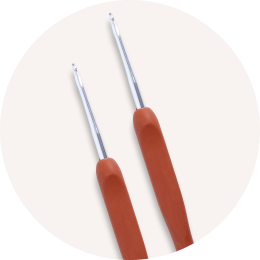
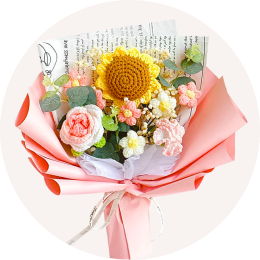
Two cotton washcloths sit on my table, same yarn, same stitch pattern, same forty-minute sitting. One was worked with a bare aluminium hook, the other with a soft-grip handle about twice as thick. The bare-hook cloth is noticeably denser — I was squeezing, and squeezing tightens tension without you deciding to. The other cloth is even, and more to the point, my thumb joint did not ache that evening.
That gap is what handle design controls. Not speed, not neatness, not skill — how much force your hand spends per stitch, and therefore how many stitches you get before the ache starts. Below is what each property of a hook or needle actually changes in your hand, which differences you can feel and which are packaging, and where the extra money buys something real.
Handle Thickness Decides How Hard You Squeeze
A plain aluminium hook measures roughly 5 to 7mm across the part you hold. Your fingertips have to pinch to stop it rotating, and pinch grip is the most fatiguing thing a hand does. Widen that to 10 or 13mm and the same hook rests against a larger patch of skin, so friction does the work your muscles were doing.
The term for the sized part of a crochet hook is the shaft — the smooth straight section that sets your stitch size. That never changes thickness for a given hook size. The handle behind it is the free variable, and it is the only part manufacturers can make thicker without changing your gauge, the number of stitches and rows you get over a set measurement.
Thicker is not automatically better. A handle wide enough to hold your fingers splayed open recruits your forearm to stabilise it, which trades a sore thumb for a sore elbow.
A quick way to test the size
- Hold the tool as you normally would and let your hand relax completely.
- Your thumb and index finger should touch the handle along their length, not just at the tips.
- If there is a visible gap between fingertip and thumb pad, the handle is too thin for you.
- If your fingers cannot curl at all, it is too fat.
Hands vary more than marketing copy admits. If your joints are already sore, the gentle techniques and ergonomic setup guidance for crocheting with arthritis covers the posture side, which handle thickness alone will not solve.
Grip Shape: Round, Flattened or Sculpted
Shape decides whether your hand can move during a session. Crocheters hold a hook one of two ways — pencil grip, thumb and forefinger near the head, or knife grip, palm over the handle — and a shape that suits one can fight the other.
| What matters | Round soft-grip barrel | Flattened thumb rest | Sculpted contoured handle |
|---|---|---|---|
| Hand position | Free — works for pencil and knife hold | Fixed thumb placement, hand angle set | Fixed, matched to one hold |
| Rotation control | Relies on grip friction alone | Flat face stops the hook twisting | Strongest control of the three |
| Long sessions | Best, because you can shift position | Good until your thumb wants to move | Excellent if it fits, painful if it does not |
| Fits most hands | Yes | Usually | Only sometimes — try before committing |
The mistake here is buying a fully sculpted handle sight unseen because it looks the most engineered. A moulded finger channel that sits 3mm off where your finger naturally lands presses on one spot for hours. A plain round grip that lets you rotate the tool every ten minutes beats a perfect-looking shape that locks you in place.
Left-handed crafters hit this hardest, because asymmetric sculpting is usually cut for right hands. The case for left-handed knitters and crocheters needing specialised hooks and needles is mostly a case about handle geometry.
Handle Material Changes Heat, Slip and Sweat
Soft-grip handles are thermoplastic elastomer or silicone — grippy, slightly cushioned, and they warm to skin temperature in a minute. That warmth matters more than it sounds, because cold metal makes stiff joints stiffer for the first fifteen minutes of a session.
Wood sits in the middle. It is warm immediately, holds a little texture, and never gets tacky in summer heat the way some soft coatings do. Sets like the  Wooden Handle Crochet Hooks 9 Pcs pair a wooden grip with a metal head, which is the combination most people end up preferring once they have tried both extremes.
Bare metal is the fastest surface and the worst for sustained grip pressure. The tool slides, so you clamp harder to stop it, and you probably will not notice you are doing it until your hand tells you an hour later. The material comparison in the five differences between bamboo and metal needles and hooks goes further into how surface friction affects stitch speed.
Weight and Balance Decide What Your Wrist Carries
Total weight matters less than where it sits. A hook with a heavy handle and a light head balances near your fingers, which means your wrist holds it steady with almost no effort. Weight out at the tip makes your wrist work as a lever for every stitch.
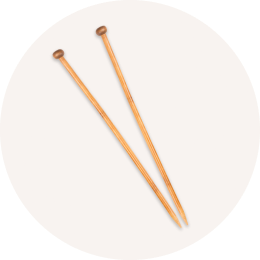
Knitters feel this far more than crocheters, because a knitting needle is longer. A 35cm straight needle loaded with a half-finished jumper puts a real lever arm against your wrist, and by hour two that shows up as a dull ache along the forearm.
Circular needles — two short tips joined by a flexible cable — solve it by letting the fabric's weight fall into your lap instead of hanging off the needle ends. That single switch reduces hand fatigue more than any handle upgrade, and it works for flat knitting as well as knitting in the round.
Heavier is occasionally the right answer. Some crafters with reduced grip strength control a slightly weighted handle better than a featherlight one, because momentum does part of the steering.
What Knitters Have to Judge That Crocheters Do Not
Crochet ergonomics stop at the handle. Knitting ergonomics continue down the cable, and a bad cable undoes a good needle.
The join
The join is where the metal tip meets the cable. If there is a lip, every stitch snags there and you push harder to move it along — that extra push, thousands of times, is a genuine source of hand strain. Run your thumbnail across the join before you buy; it should not catch.
Cable memory
Cheap cables hold the coil shape from the packet. You then fight a springy loop for the whole project, which means constant low-level grip tension. Cables that relax after a minute in warm water are worth choosing over cables that never relax.
Tip taper and length
Sharp tips push through tight stitches with less force, which is why they suit colourwork and lace. Blunt tips are kinder if you tend to split plies. Short 10cm tips on a small circular are the usual cause of cramped hands during hat knitting — go up to 13cm tips wherever the circumference allows.
What Is Worth Paying For in Ergonomic Crochet Hooks Knitting Needles
Spend on the surfaces that touch yarn or skin for hours. A polished hook head and a smooth throat — the notch under the head where the loop sits — mean the yarn releases instead of catching, and every catch is a small extra pull from your hand.
Spend on a grip material that stays dry. Cheap tacky coatings go sticky within a year, and a sticky handle drags on your skin every time you rotate the tool.
- Worth it: a smooth cable join, a polished head and throat, a grip that suits your hold, the three or four sizes you use most.
- Not worth it: exotic handle woods, twenty-piece sets where twelve sizes stay in the case, printed plastic sleeves sold as ergonomic, colour-coding you will learn by feel anyway.
A mid-range set of comfort grip tools covering the common sizes will serve you better than one expensive hook in a size you rarely reach for. Something like the  Ergonomic Crochet Hook Set 9 Pcs with Soft Grip Handles covers the range most patterns call for, then you add specialist sizes as projects demand. That order of buying is the whole argument in building a crochet toolkit gradually rather than all at once.
One more thing that costs nothing: check gauge again after switching tools. A grippier handle usually loosens your tension, and looser tension changes your finished measurements.
Ready to start a project you will actually finish?
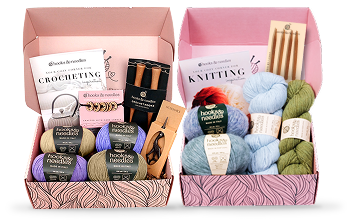
Hooks & Needles delivers a complete yarn project to your door every month — coordinated yarn, the right hooks or needles, and a pattern written to be followed rather than decoded. Pause or cancel whenever you like.
Use LEARN20 for 20% off your first box

The Short Version
Handle thickness and grip friction do most of the work of reducing hand fatigue. Everything else — weight, cable quality, tip shape — refines what those two already fixed.
What to remember
- Aim for a handle your relaxed fingers contact along their length, not just at the tips.
- Choose a shape that lets you shift hand position mid-session over one that locks you into a single hold.
- Slippery surfaces make you grip harder — warmth and friction beat polish for long sessions.
- Knitters: move fabric weight into your lap with circulars, and reject any needle with a join your thumbnail catches on.
- Recheck your gauge after changing tools, because relaxed tension changes finished size.
FAQ
My ergonomic set does not include the hook size the pattern calls for. What now?
Use the plain hook in the correct size and work a gauge swatch first — never substitute size to keep a comfortable handle, because that changes your finished measurements. To make a bare hook kinder, slide a foam pencil grip or a short length of foam pipe insulation over the handle end. It is not elegant, but it widens the grip and stops the tool rotating, which is most of what a moulded handle does.
I cannot find soft-grip handles in the size I need. Is wood or bamboo an acceptable substitute?
Yes, and for many people it is the better option. Wood and bamboo warm to skin temperature quickly and have enough surface texture that you do not clamp down to stop slipping. The trade-off is speed — yarn moves more slowly across wood than across polished metal, so tight stitchers may find it harder work. If you knit or crochet tightly, choose a metal head with a wooden handle rather than an all-wood tool.
The pattern specifies circular needles and I only own straights. Can I swap?
For flat knitting, yes — work back and forth on a circular exactly as you would on straights, and your wrists will thank you for it. For knitting in the round you cannot substitute straights at all; use double-pointed needles, or work magic loop on a single long circular of 80cm or more. Match the needle size and the tip material as closely as you can, since both affect gauge.