Short answer
- A US 8 needle is 5.0 mm, which is a UK 6 — UK numbers run backwards, so as the millimetres go up, the UK number goes down.
- Millimetres are the only measurement all three systems agree on, so treat the mm marking as the real size and the US or UK number as a nickname.
- Online charts contradict each other most often at 3.75 mm and 4.5 mm, because 3.5 mm has no traditional UK number and 3.0 mm has no standard US one.
- Measure the shaft of the needle with a needle gauge or digital calipers, never the tapered tip, and expect roughly 0.1 mm of honest variation.
You have the yarn, you have the pattern, and you are holding two needles that say something ambiguous near the join — maybe a 7, maybe nothing at all because the paint wore off years ago. The pattern calls for 4.5 mm. You have four candidates in the tin and three of them look identical. That pause, before the first cast-on stitch, is where most first projects quietly stall.
Here is which part of that worry is founded: using a needle 0.5 mm off will genuinely change the size of a fitted garment, but it will not ruin a scarf, and the bigger risk is not the chart at all — it is assuming that the right number guarantees the right gauge. Two knitters with the same 4.5 mm needle can produce fabric that differs by a full inch over 20 stitches, so the size on the needle is a starting point rather than an answer.
Before You Cast On, Find Out What You Actually Own
Start with the needles in your hand rather than the chart on your screen. Old British needles were manufactured to imperial wire gauge numbers before metrication, so a vintage UK 7 may measure 4.4 mm rather than a clean 4.5 mm, and that is not a defect — it is a different measuring system showing through.
The single thing that decides whether this stage goes well is where you measure. Needle tips taper, so a caliper reading taken 10 mm from the point will always come out small and send you to the wrong row of any chart.
- Measure the shaft, not the tip. Take the reading at least a third of the way down the needle, where the diameter stops changing — this is the part that forms your stitches.
- Use a needle gauge if you have one. Push the needle through holes until you find the smallest one it passes cleanly; if it wedges, you are between sizes and the next hole up is your answer.
- Check with calipers if the gauge is ambiguous. Digital calipers settle the 3.75 versus 4.0 mm question in seconds, and a reading within 0.1 mm of a standard size is that size.
- Mark the mm on the needle. A dab of nail polish or a labelled elastic band saves you doing this again in six months.
Coated aluminium needles read very slightly over their stated size when new and slightly under once the coating has scuffed, which is one reason a well-loved pair can start behaving differently — the way wear on hooks and needles changes each stitch is worth knowing before you blame your tension. Bamboo shifts the other way and can measure a touch under, especially in the smaller sizes.

From the Hooks & Needles shop
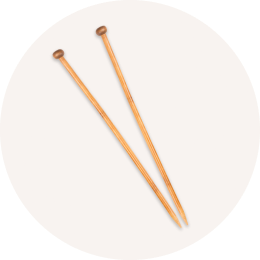
36 Pcs Bamboo Knitting Needles
A full graded set marked in millimetres removes the guessing entirely — when a pattern asks for 3.75 mm you pull out 3.75 mm instead of deciding whether the unmarked pair in the tin is close enough.
Knitting Needles Sizes That Genuinely Line Up
Metric is the spine of every knitting needle size chart worth using, because millimetres describe the physical object while US and UK numbers describe positions in a list. UK numbers descend as the needle gets thicker, a leftover from wire gauge where the number counted drawing passes, so a UK 6 is fatter than a UK 10.
These are the pairings that hold up when you measure real needles:
- 2.00 mm — US 0 — UK 14
- 2.25 mm — US 1 — UK 13
- 2.75 mm — US 2 — UK 12
- 3.00 mm — no standard US number — UK 11
- 3.25 mm — US 3 — UK 10
- 3.50 mm — US 4 — no traditional UK number
- 3.75 mm — US 5 — UK 9
- 4.00 mm — US 6 — UK 8
- 4.50 mm — US 7 — UK 7
- 5.00 mm — US 8 — UK 6
- 5.50 mm — US 9 — UK 5
- 6.00 mm — US 10 — UK 4
- 6.50 mm — US 10½ — UK 3
- 8.00 mm — US 11 — UK 0
- 9.00 mm — US 13 — UK 00
- 10.00 mm — US 15 — UK 000
Why charts disagree at 3.75 mm and 4.5 mm
The gaps cause the errors. Because 3.50 mm has no traditional UK equivalent, some charts shunt everything up a row and print 3.75 mm as UK 10 — but UK 10 measures 3.25 mm, a difference of half a millimetre across a whole sweater front.
At 4.50 mm the trouble is the coincidence: US 7 and UK 7 really are the same needle, which looks like a typo to whoever compiled the chart, so you will see 4.50 mm listed as UK 6 in an attempt to fix a mistake that was never there. When a chart and your calipers disagree, the calipers win.
Metric knitting needle sizes also skip 7.0 mm and 7.5 mm in the US system entirely, so a pattern written for UK 2 or UK 1 has no US number to give you.
Translating the Pattern Before You Wind the Yarn
Read the needle call-out as a set of instructions about fabric, not a shopping list. A UK pattern that says "4 mm (UK 8) needles" and a US pattern that says "size 6 needles" are asking for the same tool, and the thing that decides whether your translation is safe is whether you also match the stated gauge.
The common mistake happens here, and it is substitution by proximity. Reaching for 3.5 mm because the pattern wants 3.75 mm and you do not own 3.75 mm costs you roughly one stitch per 10 cm in most fingering-weight fabrics, which is a hat that fits a smaller head than planned.
Two more places patterns trip people up:
- Two sizes listed. The smaller one is almost always for ribbing or edgings, so read the whole instruction before choosing.
- Circulars sized by two numbers. The needle size is the tip diameter; the second figure is cable length and has nothing to do with gauge.
Cable length trips up more first projects than diameter does, and if you are buying your first set, a walk-through of which circular needles to buy first covers which lengths actually earn their place.
The Swatch Decides It, Not the Chart
Gauge — called tension in UK patterns — is the number of stitches and rows in a 10 cm square of your fabric, and it is the only measurement that tells you whether the needle is right for you. The chart gets you to the correct starting needle; your hands decide whether that needle produces the pattern's fabric.
Cast on at least 30 stitches and work at least 10 cm before you measure, because edge stitches distort and a small swatch flatters you. Then block it the way you will wash the finished item, since wool in particular can relax by half a stitch per 10 cm once wet.
If you set a swatch aside mid-measure, live stitches slide off the moment you put the needles in a bag —  Knitting Needles Point Protectors 6pcs are the cheapest way to avoid re-knitting it.
One last thing that catches people: needle material changes gauge even at identical diameters, because yarn slips faster on metal than on bamboo and most knitters unconsciously tighten to compensate. Swatch with the needles you plan to use for the whole project.
Ready to start a project you will actually finish?
Hooks & Needles delivers a complete yarn project to your door every month — coordinated yarn, the right hooks or needles, and a pattern written to be followed rather than decoded. Pause or cancel whenever you like.
Use LEARN20 for 20% off your first box

Where To Go From Here
Label your needles in millimetres this week, before your next project, and the conversion question mostly disappears. From then on a pattern asking for US 8, UK 6 or 5.0 mm is the same request and you can answer it in ten seconds.
Keep the needle size guide above for the two rows that cause the arguments — 3.75 mm is UK 9, and 4.50 mm is UK 7 as well as US 7. Everything else in the chart is uncontroversial.
Then let the swatch have the final word. Choosing needles by measurement and confirming by gauge is the habit that separates a jumper that fits from one that fits somebody else, and the Hooks & Needles Learning Hub approach to building technique is built around the same order of operations.
FAQ
What size is a US 8 knitting needle in mm and UK sizing?
A US 8 needle is 5.0 mm, which is a UK 6. If a chart tells you US 8 is UK 8, it has confused the two numbering systems — UK numbers run in the opposite direction to US ones.
My needle measures 3.8 mm. Is it a 3.75 or a 4.0?
Call it 3.75 mm. Readings within roughly 0.1 mm of a standard size are that size, and a genuine 4.0 mm needle will read 3.95 to 4.05 mm on the shaft rather than 3.8 mm.
I am halfway up and the piece is coming out too narrow. Do I change needles now?
Changing needles mid-piece leaves a visible line in the fabric where the stitch size shifts, so it only makes sense at a natural break such as the end of ribbing. For anything fitted, ripping back to the start is faster than altering the rest of the pattern to compensate.
My pattern gives a UK size with no millimetres. What do I use?
Convert through the chart above and check the stated tension, because older UK patterns were written for needles made to imperial gauge and may sit a fraction off modern metric sizes. If your swatch matches the tension, the needle is correct regardless of the number stamped on it.
Does any of this apply to crochet hooks?
Only partly. Hooks share the same millimetre scale, but US hooks use letters as well as numbers and the UK hook numbering is a separate sequence from UK needle numbering, so a needle conversion chart will not translate hooks correctly.