Quick Summary
You are trying to work out which monthly crochet box is worth the money, and every review page counts skeins instead of finished objects. By the end of this you will know the three things that actually separate one box from another — cost per finished project, yarn suitability, and how honestly the pattern is graded — plus where a competitor beats us. If you have a drawer of half-worked squares from boxes that looked generous, this is for you.
Ask in any crochet group which subscription box to pick and the answers arrive in grams. "That one sends four skeins." "You get more yarn for your money with the other." The assumption underneath is that a monthly crochet kit is a yarn delivery, and the winner is whoever ships the most fibre per payment.
What actually happens is that yarn quantity has almost nothing to do with whether a box was worth it. A box earns its keep when the project comes off the hook and gets used, and that outcome is decided by pattern clarity, by whether the yarn suits the stitch pattern it was paired with, and by whether the difficulty label is honest. Below, each of those gets taken apart in turn, with named boxes and the places we lose.
The Value Test Is Cost Per Finished Project
Divide what you paid by the number of things you finished, not by the number of skeins you received. A box that sends three balls of yarn and one pattern you complete has cost you one finished object. A box that sends five balls and a pattern you abandon at row twelve has cost you a bag of orphan yarn in a weight you may never match again.
This is why stash-clearance style boxes look cheap and behave expensively. Darn Good Yarn's subscriptions, for instance, are generous on quantity and lovely on colour, but they are yarn-led rather than project-led, so the pattern-to-yarn match is your job.
A crochet box is only good value at the moment the project comes off the hook — everything before that is just yarn you have paid for.
What goes wrong here
The most common mistake is buying on gram count and then discovering the yardage does not cover the size you want. Yardage, not weight, determines how far a skein goes, and a dense wool blend at 100g can give you a third less length than a lofty acrylic at the same weight.
The second mistake is treating leftover yarn as a bonus. Two hundred metres of an unlabelled DK you cannot buy again is not stash — it is a constraint on your next project. If you want a genuinely fair baseline for comparison, price up a single pattern such as the  Blue Horizon Travel Cap Crochet Pattern plus the yarn it calls for, and compare that total against a month of any box.
Luxury Fibre Is Not the Same as the Right Yarn
Merino, alpaca and silk blends photograph beautifully and read as quality on a product page, but "quality" in a crochet context means suitability for the stitch pattern in the envelope. A single-ply merino is a joy in garter stitch and a nightmare in dense single crochet worked into the back loop, because it splits every time the hook enters the stitch.
The properties that actually matter are ply count, twist and how much the yarn splits under a hook. Crochet consumes roughly a third more yarn than knitting for the same area, and it puts the hook tip through the strand rather than around it, so a tightly plied yarn outperforms a softer, loftier one that a knitting box would rate highly.
So is acrylic in a subscription box a bad sign?
Not at all — a good acrylic or acrylic blend is hard-wearing, washable and forgiving on the hands, which is exactly what you want for a baby item or a first garment. The warning sign is a squeaky, loosely spun budget acrylic that fuzzes as you frog it, because you will be frogging while you learn.
One habit is worth more than any fibre upgrade: work a small gauge swatch with the hook the box supplied, then compare it with the gauge printed on the pattern before you start. Gauge is the number of stitches and rows in a measured square, and five minutes checking it saves an afternoon of a hat that fits a melon.
"Easy" Is Not a Standard, and One Rival Does It Better
Difficulty labels are set by each company with no shared scale behind them, so an "easy" crochet pattern from one box can assume you already read charts while another means chain, single crochet, repeat. There is no governing body checking this. The word tells you about the publisher's expectations, not about your skill.
KnitCrate's crochet crates, in our experience of working them, are pitched at a confident advanced beginner upward — the patterns are well written but they expect you to handle shaping and stitch multiples without a diagram. Yarnyay leans playful and colourful with a similar assumption baked in.
Where The Crochet Society wins
For a genuine first-ever project, The Crochet Society does hand-holding better than we do. Its beginner tier breaks a single technique into a whole month, the printed instructions repeat themselves deliberately, and the community around it is large enough that someone has already asked your question. If you have never made a slip knot, that is a real advantage and we are not going to pretend otherwise.
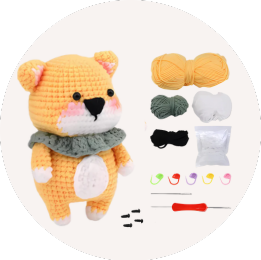
Where we pull ahead is the step after that — the month you want to make something that looks like the photo without being walked through a chain stitch again. If you are weighing up the absolute entry point, our rundown of subscription boxes suited to complete beginners is more useful than this section alone, and a self-contained starter set like the  29-Piece Crocheting Kit: Perfect for Beginners answers the tool question before any subscription starts.
What the Best Crochet Subscription Box Actually Gets Judged On
Three dimensions decide it, and they are all measurable before you subscribe. Cost per finished project, yarn suited to hook work, and a pattern graded honestly enough that you know what you are walking into. Everything else — packaging, extras, a tote bag — is pleasant and irrelevant.
| What matters | Hooks & Needles | KnitCrate | The Crochet Society |
|---|---|---|---|
| Cost per finished project | One complete project per box, so the maths is fixed | Strong yarn value, but project scope varies by crate | One project per box, weighted toward small items |
| Yarn quality for crochet | Coordinated, plied yarn chosen for the stitch pattern | Excellent fibres, some chosen with knitters in mind | Reliable mid-range yarn, safe rather than special |
| Pattern difficulty | Written without skipped steps, advanced beginner up | Assumes shaping and stitch multiples already make sense | Gentlest entry point of the three |
| Tools included | The hooks or needles the project needs | Yarn-focused; tools usually separate | Tools appear in some cycles, not all |
Read that table as a shape rather than a scoreboard. Contents rotate every cycle at all three companies, so check the current month's listing before you commit, and treat any review older than a year as history rather than description.
Half the Boxes You're Comparing Are Knitting Boxes
Several well-reviewed "crochet" subscriptions are knitting boxes that include a crochet option, and it shows in the hook. A knitting-first company sizes yarn by needle recommendation, then supplies whatever hook is nearest, which is how you end up with a 4mm hook and a yarn happiest at 5mm.
You can spot it on the product page. If the crochet pattern is described in needle sizes, or the hook is listed as an accessory rather than the tool, the box was designed around knitting. That is fine if you do both crafts — our notes on picking a box when you knit and crochet go into how to judge those fairly.
What goes wrong here
Hook sizing is the trap. US letter sizes and millimetre sizes do not map cleanly onto each other, and an H that measures 5mm from one brand can measure 5.25mm from another, which is enough to shift your gauge by half a stitch per inch across a hat brim.
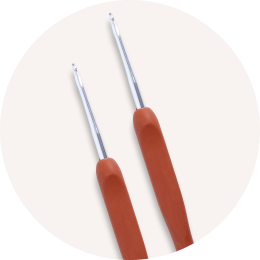
The fix is unglamorous: own a millimetre-marked set and ignore the letters entirely. An  8 Pcs Purple Crochet Hook Set covers the common range so you can swap up or down a size when your swatch says the supplied hook is wrong.
Crochet Subscription Reviews Mostly Rate the Unboxing
Almost every review you will find was written within an hour of the parcel arriving. It describes tissue paper, colour and how many skeins fell out. Not one sentence of it can tell you whether the pattern's row 14 makes sense, because the reviewer had not reached row 14 when they hit publish.
The reviews worth reading are the ones with a photograph of a finished object made from that month's pattern. Those are rarer, and they will tell you the two things that matter — whether the yardage was actually enough, and where the instructions went vague.
Support material changes this equation too. When a pattern is backed up by a written walk-through of the tricky round, most people get past the sticking point instead of putting the project in a drawer, which is the argument for subscriptions that include tutorial support alongside the pattern.
Judge a box by its finish rate, not its unboxing.
Ready to start a project you will actually finish?
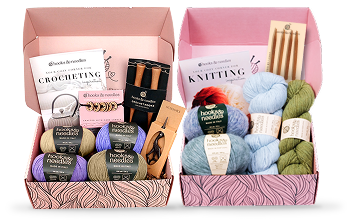
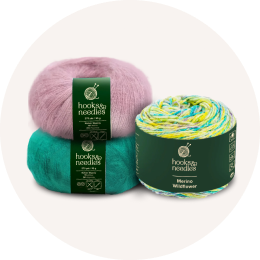
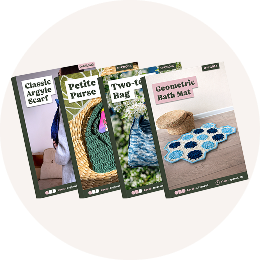
Hooks & Needles delivers a complete yarn project to your door every month — coordinated yarn, the right hooks or needles, and a pattern written to be followed rather than decoded. Pause or cancel whenever you like.
Use LEARN20 for 20% off your first box

The Short Version
Count finished projects, not skeins. Cost per completed object is the only value figure that survives contact with reality, and leftover yarn in an unmatchable weight is a cost rather than a saving.
Pick yarn by ply and twist rather than by fibre prestige, because crochet puts the hook through the strand and splitty luxury yarn punishes that. Treat every difficulty label as one company's opinion, and if you have never held a hook, The Crochet Society's beginner tier will hold your hand more than ours does.
Check that the box is built around a hook and not a needle, own hooks marked in millimetres, and ignore any review written before the reviewer reached the end of the pattern.
FAQ
If yarn quantity does not matter, am I being overcharged for less yarn?
You are paying for the pairing rather than the poundage — yarn selected for the stitch pattern, the hook it needs, and a pattern written through the difficult parts. If you would rather buy fibre in bulk and choose your own projects, a yarn-only subscription genuinely is the better purchase, and it is a different product from a monthly crochet kit.
You admit a rival is better for beginners — why would I start with you?
Because most people spend one or two months at absolute-beginner level and years at the stage after it, where patterns start assuming things and stop explaining them. Our patterns are written for that second stage without skipping the steps other publishers drop, so you are not looking for a new box three months in.
How do I check cost per finished project before subscribing?
Look at how many completed items the box promises per cycle, then divide the price by that number rather than by the skein count. If the listing describes contents but never names a finished object, assume the answer is zero guaranteed projects and price it as yarn.
Does the same comparison work for knitting subscriptions?
The cost-per-project and honest-grading tests transfer directly, but the yarn test does not — knitting is kinder to loosely spun singles that split under a hook, so a yarn that disappoints in single crochet can be perfect in stockinette. Judge yarn by the craft you will actually use it for.
What if my gauge swatch does not match the pattern?
Change hook size rather than trying to change your tension, since tension is a habit and fighting it produces uneven fabric. Too many stitches in your measured square means go up a size; too few means go down, and re-swatch until the numbers match before you start the real piece.