Quick Summary
You used the hook size the pattern asked for, counted your stitches twice, and your swatch still measures wrong. By the end of this you will know which part of your hook is causing it, how to prove it in ten minutes, and what to do with the piece you have already worked. If you have ever bought a second hook in the same size and quietly got a different fabric, this is about you.
Look at the swatch in your hand. Twenty rows of double crochet, worked in the yarn the pattern named, on the 5.0 mm hook the pattern named — and it is shorter than the pattern says it should be, or taller, by enough that you noticed without measuring. The stitch count is right. The rows are even. Nothing looks wrong until you put a tape measure against it.
That gap between correct stitches and incorrect measurements almost never comes from counting. It comes from the shape of the metal your loops travelled over, from how far up the hook you pulled them, and from how much the yarn dragged on the way. Those causes are ranked below, most likely first, each with a way to confirm or dismiss it before you buy anything.
Cause 1: An Inline Hook Where the Pattern Used a Tapered One
Two hooks stamped 5.0 mm can produce different fabric, and the difference lives in the throat. The throat is the sloped section between the point of the hook and the straight shaft — the part that guides the yarn from the tip down to full width. It is the least standardised feature on any hook you can buy.
Inline versus tapered, in plain terms
An inline hook has a throat cut straight back, so the head sits flush within the diameter of the shaft. A tapered hook has a gradual, rounded throat that widens toward the shaft, so a loop rides up a slope before reaching full size. Susan Bates hooks are the classic inline shape; Boye hooks are the classic tapered one.
The practical result is that on a tapered hook the working loop spends part of its life on a curve rather than a cylinder, and it tends to come off slightly larger.
What the swatches actually measured
We worked 20 rows of double crochet in the same worsted weight yarn (medium, category 4), same skein, same hands, same evening. One swatch on an inline 5.0 mm, one on a tapered 5.0 mm. The inline swatch came out 197 mm tall. The tapered one came out 209 mm.
Twelve millimetres — a shade under half an inch — across 20 rows. Scale that to a 60-row cardigan front and you have gained more than an inch of length you never asked for.
How to confirm or rule this out
Hold your hook side-on against a bright window and look at the profile of the throat. If the head appears to sit inside the line of the shaft, it is inline. If the metal swells outward from the tip to the shaft in a smooth curve, it is tapered. Then check your other hook in the same size — if the profiles differ, you have found your variable, and the mistake to avoid is swatching on one and working the project on the other.
Worn hooks muddy this test, because an abraded throat behaves like neither shape cleanly. If yours has been in a project bag for a decade, it is worth knowing how surface wear on hooks and needles alters each stitch before you blame your tension.
The movement described above is easiest to judge while a stitch is being made, so here is a double crochet worked from yarn over to final pull-through.
DOUBLE CROCHET FOR COMPLETE BEGINNERS
Cause 2: What a Crochet Needle's Stated Size Does and Doesn't Tell You
Crochet needle or crochet hook?
A crochet needle is the same tool as a crochet hook — the word "needle" is common usage, particularly in translated patterns and outside the UK and US. The difference from a knitting needle is structural, not cosmetic. A knitting needle is a smooth shaft that holds many live loops at once; a crochet hook has a hooked head and a thumb rest, and it holds exactly one working loop at a time.
That single working loop is why hook shape matters more here than needle shape does in knitting.
The stamped size measures the shaft, and only the shaft
When a hook is labelled 5.0 mm, that figure describes the diameter of the straight shaft behind the throat. It says nothing about how long the throat is, how steeply it slopes, how deep the mouth of the head is, or how far the thumb rest sits from the tip. Two identical numbers can therefore describe two different tools.
Letter sizes make this worse. An H/8 is nominally 5.0 mm, but letter-to-millimetre conversions vary between manufacturers, so trust the millimetre marking over the letter every time. If the millimetre figure has worn off, measure the shaft with callipers rather than guessing from the case it came in.

From the Hooks & Needles shop
Crochet Hook Set 16 Pcs with Case
Once you know your hook shape runs large or small, hitting gauge means stepping half a size in the same profile — which is only possible if you own a consistent range rather than a drawer of mismatched singles.
How to confirm or rule this out
Measure the shaft of the hook you actually used and compare it to the millimetre size the pattern states. If they match and your gauge is still off, sizing is not your problem and you can stop chasing it — move to Cause 3. If they do not match, the whole question of which size to reach for next is covered in this walkthrough of choosing a crochet hook size without guesswork.
Want the yarn, the pattern and the guidance in one box?
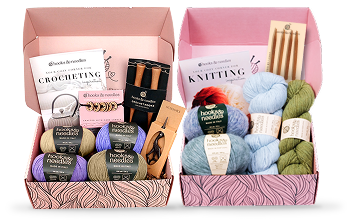
Each Hooks & Needles box arrives with the yarn, the tools and an exclusive pattern already matched to each other, plus instructions that do not skip the step you are stuck on. Nothing to source, nothing to substitute.
Use LEARN20 for 20% off your first box

Cause 3: Your Loops Are Sitting on the Throat, Not the Shaft
Even the right hook gives the wrong gauge if the yarn never reaches the widest part of it. Each loop should be seated on the straight shaft when you draw the next one through. If you snug the working loop up toward the tip — a habit that feels tidy and controlled — every stitch is being formed on a narrower slice of metal than the stamped size.
On a tapered hook this is dramatic, because the taper is long. Pull your loops forward on a tapered 5.0 mm and you may be crocheting at an effective 4.2 mm without changing a thing about your hands.
The two habits that cause it
- Tightening the working loop after each pull-through, which drags it up the slope toward the head.
- Gripping the hook so far back on the thumb rest that you rotate the tip down and work off the point rather than the shaft.
The opposite mistake exists too. Some crocheters let loops slide behind the shaft onto the handle, which is wider on many hooks, and produce fabric that is loose and floppy at a stated size that should have given a firm stitch.
How to confirm or rule this out
Work five double crochets slowly and watch where the loop rests at the moment you yarn over. If it is anywhere but the straight section, that is your gauge problem, and it is free to fix. Re-swatch consciously seating each loop on the shaft, then measure — a 5 to 8 percent change in row height is normal from this alone.
Cause 4: The Hook Material Is Changing Your Tension
Crochet hook material is the smallest of the four causes, but it is real, and it stacks on top of the others. Aluminium and steel let yarn slide, so loops tend to sit at whatever size your hands set. Bamboo and wood grip slightly, holding a loop where it was placed and often producing marginally tighter fabric with grabby fibres like wool or cotton.
The comparison between the two materials, including how they behave with splitty yarn, is set out in this piece on the differences between bamboo and metal hooks and needles.
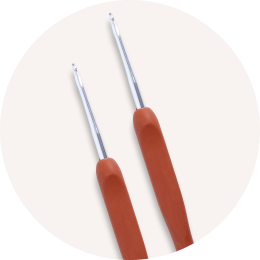
Handle shape matters for a different reason. A hook that hurts to hold changes your grip over the course of a session, and a grip that changes mid-project gives you gauge that changes mid-project — which is why a padded handle such as the  Crochet Hook Set 9 Pcs with Soft Grip Handles earns its place on a long blanket.
The fix, in order
Work through these before you change hook size, because changing size to compensate for shape hides the problem rather than solving it.
Blocking is the step people skip. Wetting or steaming the swatch and letting it dry flat relaxes the stitches into their finished dimensions, and a swatch that measured 12 mm short can close most of that gap once blocked.
The Short Version
Your hook size was never the whole specification. The throat shape, the seating of the loop and the material are all doing measurable work, and the one your pattern never mentions is the throat.
What to remember
- The stamped millimetre size describes the shaft only — nothing about the throat that shapes every loop.
- Inline and tapered hooks in the same size gave a 12 mm difference over 20 rows of double crochet.
- Seat each working loop on the straight shaft; loops held on the taper crochet a size smaller than you think.
- Swatch and block with the exact hook you will use for the project, not a same-size substitute.
- Change throat shape or loop placement first; change hook size last.
FAQ
I am 30 rows into a blanket at the wrong gauge. Do I have to frog it?
For a blanket, usually not. Measure what you have, work out the finished dimensions at your actual gauge, and decide whether that size is acceptable — often it simply means fewer or more rows than written, plus extra yarn. Frogging becomes worth it when the fabric density is wrong rather than the size: if 30 rows feel stiff and boardy, or so loose you can see through them, no amount of recalculating fixes that. For garments, frog. An inch of drift across a cardigan front does not hide.
Can blocking rescue a piece that already came out too small?
It can recover a useful amount, but not unlimited amounts. Wool and other animal fibres respond best — wet the piece, pin it gently to the target measurements, and let it dry fully in place. Expect to gain a few percent, not ten. Cotton and acrylic move much less, and acrylic can be steam-relaxed only once before the stitches stop springing back at all. Block a swatch first so you find the limit on 20 rows rather than on the finished project.
My finished hat came out too big. Can I save it without starting over?
Often yes, because hats are worked in the round and the crown is the fixed part. Undo the final rounds of the brim and rework them on a hook one size down, or add a round of single crochet worked into the back loops only, which pulls the edge in. If the whole hat is loose rather than just the brim, thread a length of the same yarn through the inside of the brim and gather it slightly — invisible from the outside, and reversible if you get it wrong.