Quick Summary
You are trying to work out whether a seasonal box is worth ordering when you already get the standard one, and nobody has explained what is genuinely different inside. By the end of this you will know exactly which four things change — yarn selection, pattern timing, skill level and availability — and how each one affects whether the project actually gets finished. If you have ever bought a themed kit in October and still had it in the bag by February, this is for you.
The assumption goes like this: a seasonal box is the normal box with orange yarn in October and red yarn in December, priced a little higher because someone printed a snowflake on the sleeve. Plenty of craft subscriptions do work that way, so the suspicion is earned. It just is not what is happening here.
What actually changes is the order the box gets built in. A standard box starts with a pattern someone wanted to write and finds the right yarn for it. A seasonal box starts with a date on a calendar and works backwards — which decides the yarn weight, the project size, the technique load and how long the whole thing stays available. Colour is the last decision made, not the first.
The Yarn Is Picked for What the Object Has to Do
Seasonal projects are usually objects that live differently from a scarf. Bunting hangs and needs to hold a straight edge. Ornaments get stuffed and need a fabric dense enough that the filling does not show through. A table runner gets washed after every gathering. None of those requirements are satisfied by simply recolouring whatever yarn the standard box was going to use.
That is why you will sometimes find a firmer, tighter-spun yarn in a seasonal box than you expect. It is not a downgrade in softness for the sake of it — it is a fibre chosen because the finished thing has to hold a shape rather than drape.
The mistake this causes is real, and it happens at the swatch stage. You feel yarn that is crisper than your usual and you go up a hook or needle size to make it feel nicer in your hands. Now your gauge — the number of stitches and rows in a measured square, which is the only thing keeping your finished size honest — is loose, your stuffing shows, and your ornament sags.
Can I just substitute yarn from my stash if I do not like the feel?
You can, but match the yarn weight category and the fibre behaviour, not just the thickness. A superwash merino at the same weight as a firm cotton will bloom and soften after blocking, which is lovely in a cowl and disastrous in a stiff-edged star. If you swap, swatch and block the swatch before you commit.
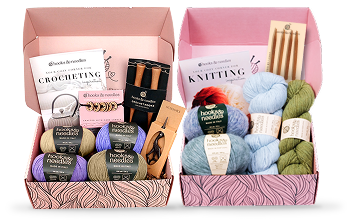
If you want a sense of how the standard contents are assembled before you compare, the full breakdown of what is inside a Hooks and Needles box lays out the yarn, tools and pattern side by side.
A Hooks and Needles Seasonal Box Is Built Backwards From a Date
Every seasonal project has a deadline that the standard box does not have. A cardigan is finished when it is finished. A set of Easter decorations is finished by Easter or it goes back in the cupboard for eleven months, which is how most seasonal makes quietly die.
So the project is scoped to the window. That usually means several small components rather than one large piece, because five small motifs give you five finish points and a blanket gives you one. It also means the pattern is written with the assumption you have evenings, not weeks.

From the Hooks & Needles shop
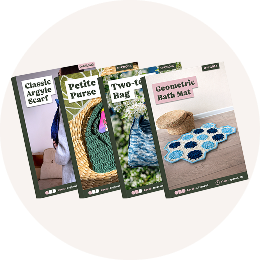
Limited Edition Easter Special Collection
A set of small, date-anchored projects is exactly the shape that works when you have a fixed weekend to hit rather than an open-ended month.
Order early and you get the second thing the date buys you: recovery time. If your gauge is off on the first motif, you can frog it and redo it without losing the occasion. Order two weeks out and every mistake becomes a decision about whether to accept a wonky one.
Here is the pro-tip version. Work the smallest component in the pattern first, all the way to finishing and blocking, before you touch the rest of the yarn. It functions as a full-scale swatch, it tells you your true gauge in the actual stitch pattern, and it gives you one completed thing on the table within the first evening.
Want the yarn, the pattern and the guidance in one box?
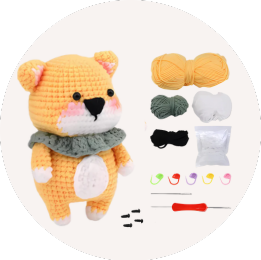
Each Hooks & Needles box arrives with the yarn, the tools and an exclusive pattern already matched to each other, plus instructions that do not skip the step you are stuck on. Nothing to source, nothing to substitute.
Use LEARN20 for 20% off your first box

Limited Edition Does Not Mean Advanced
There is a quiet fear that a special edition is a showpiece, and that ordering one means committing to colourwork, cables or an intarsia chart you cannot read. The opposite tends to be true, because a project with a deadline cannot afford a technique that stops you for three days.
What a seasonal pattern will often do is introduce exactly one new thing. A magic ring. Working in the round without a seam. Attaching a small piece to a larger one so it sits flat. One technique, taught in full, then repeated across several components so it is actually in your hands by the end.
The crochet and knitting split matters here. Small stuffed seasonal shapes lean crochet, because single crochet worked in a spiral gives you a dense fabric with no ladder gaps and no seam. The knitted equivalents in a holiday edition are more often flat panels, garter-stitch shapes or simple stranded bands, since a knitted fabric at the same gauge is naturally more open.
When the Run Ends, the Yarn Does Not Come Back
This is the part that genuinely separates a limited edition yarn box from the standard one, and it is the least discussed. Seasonal colourways are dyed in a set quantity for a set window. When that run is gone, it is not restocked in March, and the closest match next year will be a different dye lot.
Dye lot is the batch identifier printed on the ball band. Two balls of the same named colour from different lots can differ enough that the join shows as a faint stripe under daylight, even when they look identical indoors. On a small ornament that is invisible; across a runner it is the thing your eye lands on every time.
So the mistake to avoid is splitting a seasonal project across two seasons. If you plan to make a matching set over two years, buy the yarn for both while the run is live, or accept from the start that the second set will read as a slightly different shade. Colour behaving differently from the photo is one of the main reasons a finished project does not match the pattern image, and lot variation is a large part of it.
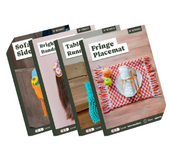
Other limited runs work the same way, including pattern-only collections such as  9 Crochet & Knitting Patterns - 4th of July Collection | Hooks & Needles, where you supply your own yarn and the timing pressure sits entirely on the making rather than the shipping.
What To Do Next
Pick your date first and count backwards. Give yourself the shipping window, one evening for the first component, and a buffer week for the redo you will probably need. If that maths does not work for this season, order for the next one rather than starting late.
Then decide what you are actually buying — a seasonal box for a dated make, or the standard box for open-ended making. They are not competing. They solve different problems, and knowing which problem you have is most of the decision.
What to remember
- Seasonal yarn is chosen for how the finished object behaves, so do not size up your hook or needle just because the yarn feels firm.
- Work the smallest component to completion first — it is a full-scale gauge check and an early win.
- A limited edition pattern usually teaches one new technique properly rather than stacking several.
- Buy all the yarn for a multi-year set in one run, or expect a visible dye lot difference.
- Order with a buffer week so a mistake costs you time, not the occasion.
FAQ
If the pattern is the real difference, can I just buy the pattern and use my own yarn?
You can, and for pattern-only collections that is the intended route. The trade-off is that you take on the yarn matching yourself — weight category, fibre behaviour after blocking, and enough yardage in a single dye lot. That is very doable if you have stash you know well, and frustrating if you are guessing from a screen.
Does a holiday edition cost more for the same amount of yarn?
Compare what the box is for rather than the gram count. A seasonal box is usually several small finished objects rather than one larger piece, so the yarn is often split across colours, which costs more to produce than a single large put-up. Judge it on whether you end the month with finished things.
I missed the window. Is a late seasonal box pointless?
Not at all — it is just a different project. Working a set of decorations in January with no deadline is the calmest version of that make, and you have them ready eleven months early. The only thing you lose is the occasion, not the skills or the finished objects.
Are seasonal boxes a safe gift if I do not know the person's skill level?
They are reasonable, because the technique load is deliberately kept low, but the deadline can create pressure a new maker does not want. If you are unsure, the points every gift buyer should check before choosing a gift subscription covers how to match the format to the recipient.
What if I run short of a limited colour halfway through?
Stop and rework the plan rather than ordering a replacement blind. Check your gauge first — running short is most often a symptom of working looser than the pattern's stated tension, which uses more yarn per row. Tightening back to gauge frequently recovers the shortfall without needing more yarn at all.