Quick Summary
The yarn band says 5mm, you used 5mm, and the square still came out boardy and small. That number is a suggestion aimed at average tension, not a rule — and by the end of this you will be able to pick up a swatch, feel it, and say which direction to move your hook. If you have ever finished something that technically followed the pattern but felt wrong in the hand, this is the missing piece.
Two granny squares sit on the table in front of me, worked from the same ball of DK cotton, same stitch count, same evening. The left one is 11cm across and stands up when you prop it against a mug — it has the stiffness of a coaster. The right one is 13.5cm, sags over the edge of your hand, and the holes between the clusters are wide enough to see the table through. One hook size apart. That is the whole difference.
Neither square is wrong, exactly. The stiff one would make a decent potholder and a miserable blanket; the loose one would drape beautifully across a pram and let a draught straight through a cushion cover. What changes between them is not skill and not the pattern — it is the relationship between the hook and yarn you put in your hands, and once you can read that relationship in a finished swatch, you stop guessing and start choosing.
What the Hook and Yarn Pairing Actually Controls
A hook does one job: it holds a loop at a fixed diameter while you pull the next one through. Bigger loop, bigger stitch, more space between the strands of yarn. Everything you notice about a finished piece — how it drapes, how warm it is, how well it holds its shape — comes downstream of that single measurement.
The word for this is gauge — the number of stitches and rows that fit into a 10cm square of fabric. Tight gauge means more stitches crammed into that square. Loose gauge means fewer, larger ones. Pattern designers write their instructions assuming a specific gauge, which is why a jumper that says "worked at 16 stitches to 10cm" comes out two sizes too small if you hit 19.
Can I just change hook size to fix a garment that came out the wrong size?
Sometimes, and it is often the fastest fix — going up one size typically adds around 5 to 8 percent to the finished width. But it also loosens the fabric, so a jumper that now fits will drape more than the designer intended. For anything fitted, rework the swatch first rather than committing forty hours to a guess.
Here is what those three squares looked like side by side, all worked in the same DK cotton with the same stitch count.
| What matters | 4.5mm hook | 5mm hook (band suggestion) | 5.5mm hook |
|---|---|---|---|
| Finished size | 11cm | 12cm | 13.5cm |
| Feel in the hand | Board-like, holds a fold | Firm but bends over the palm | Fluid, sags under its own weight |
| Stitch definition | Crisp, slightly crowded | Clear and even | Open, clusters lean |
| Hook movement | Fights every insertion | Slides with mild resistance | Almost no resistance |
| Suits | Baskets, coasters, bag bases | Blankets, cushions, most patterns | Shawls, summer wraps, layering |
Notice that the hook movement column tells you as much as the size column. If you are wrestling the hook into every stitch, your fabric is already too dense — you do not need a ruler to know that.
Yarn Weight: The Number That Sets Your Starting Hook
Yarn weight means thickness, not how much the ball weighs. It runs from lace at the fine end through 4ply, DK, aran, chunky and super chunky, and it is the single best predictor of which hook to reach for first. Every band carries it, usually as a small symbol with a number inside.
These are sensible starting points, not commandments:
- 4ply / fingering: 2.5–3.5mm
- DK / light worsted: 3.5–4.5mm for dense work, 4.5–5mm for most patterns
- Aran / worsted: 5–6mm
- Chunky: 6–8mm
- Super chunky: 9mm and up
The question of what hook for DK yarn comes up constantly, and the honest answer is that 4mm and 5mm both make perfectly good DK fabric for completely different purposes. If you want to understand why the categories overlap rather than stack neatly, the breakdown of the seven yarn weights and how they behave in practice is worth twenty minutes.
What goes wrong here
The most common mistake is treating the band number as a target to hit rather than a place to start. Band recommendations are generated for average tension in plain single crochet, and almost nobody works plain single crochet at average tension. If your pattern uses tall stitches, textured clusters or colourwork, the band was never describing your project in the first place.
The second mistake is quieter: substituting a yarn weight without adjusting the hook. Swapping aran for DK because the colour was nicer, then keeping the 4mm hook, gives you a fabric with the density of cardboard and a finished piece two sizes off. Change the yarn, change the hook, reswatch.
Chunky and super chunky yarns are where hook size stops being a fine adjustment and becomes structural — a 9mm and a 10mm produce genuinely different objects. A dedicated set like the  Large Crochet Hooks for Chunky Yarn covers the range that standard sets usually stop short of.
Reading Your Own Fabric Instead of the Label
Work a swatch about 12cm square in the stitch your pattern actually uses, fasten off, and put the ruler down for a moment. Hold it flat on your palm and tip your hand. A fabric at the right density will bend over the edge of your hand but keep its shape. That is the whole test.
If it stands up stiffly and barely bends, you are working too tight for that yarn — go up half a millimetre. If it pours off your hand like a wet flannel and the stitches lean into each other, go down. Both directions are one hook size, not two, unless the swatch is dramatically off.
What goes wrong here
Tight crocheters often reach for a larger hook to fix the fabric, which works — but only if the tension itself is even. A larger hook applied to erratic tension gives you erratic loose stitches instead of erratic tight ones, and now the unevenness shows more because the holes are bigger. Fix consistency first, size second.
The other trap is swatching in plain rows for a project worked in the round or in clusters. Granny squares, amigurumi and textured stitch patterns all pull differently from flat double crochet, sometimes by a full hook size. Swatch what you are making.
One thing that saves a lot of reworking: wash and dry the swatch the way you intend to wash the finished piece. Cotton relaxes, superwash wool grows, and acrylic barely moves — a swatch that looked perfect dry off the hook can be a different fabric entirely after a soak. Ten minutes in a bowl of water tells you more than another hour of measuring.
Want the yarn, the pattern and the guidance in one box?
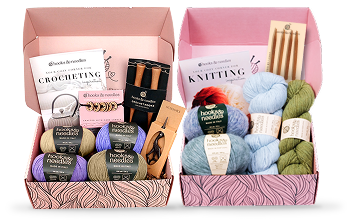
Each Hooks & Needles box arrives with the yarn, the tools and an exclusive pattern already matched to each other, plus instructions that do not skip the step you are stuck on. Nothing to source, nothing to substitute.
Use LEARN20 for 20% off your first box

Hook Material, Throat Shape and Grip Change the Result Too
Two hooks stamped 5mm can give you different gauge, which is maddening the first time it happens. The shaft may be the stated diameter, but the throat — the tapered section between the hook head and the shaft — varies by manufacturer, and some loops never make it up to full shaft width before you pull the next one through.
Inline, tapered and the gauge gap
Inline hooks have a head cut flush with the shaft, giving a consistent loop size and slightly tighter fabric. Tapered hooks have a rounded, narrowing throat that lets the loop slide more freely and generally runs a touch looser. The mechanics of that difference are laid out in detail in this look at why the right hook size can still give you the wrong gauge.
Material matters less than people expect, but it is not nothing. Aluminium is slick and fast, good for cotton and anything that grips. Bamboo and wood have more friction, which helps slippery yarns stay put and slows down speed demons. Plastic sits between the two and flexes slightly under pressure.

From the Hooks & Needles shop
Crochet Hook Set 16 Pcs with Case
Having half-sizes on either side of your usual hook is what makes the swatch-and-adjust method possible — this set covers the range in one case so you are never one size short mid-project.
None of this means you need matching hooks from one brand. It means that when you find the pairing that works, note the brand alongside the size — "5mm, the bamboo one" is more useful information than "5mm".
What Is Worth Paying More For, and What Is Not
Ergonomic handles are worth the money if you crochet for more than an hour at a stretch. A wider grip changes how much your thumb and forefinger have to pinch, and pinch pressure is what turns into wrist ache and, eventually, tight uneven tension. This is the one upgrade most people notice within a single session.
Consistent sizing across a set is the second thing worth paying for. Cheap mixed bundles often run half a millimetre off their stamped size, which quietly undermines every swatch you make. If you are assembling crochet supplies as a beginner, one reliable set beats three unreliable ones.
Where the extra money does nothing
- Decorative handles and resin inlays: lovely to look at, no effect on gauge or comfort.
- Interchangeable hook systems: useful for Tunisian crochet, unnecessary for standard work.
- Premium metals: a mid-range aluminium hook glides as well as an expensive one.
- Huge sets with sizes you will never use: most crocheters live between 3.5mm and 6mm.
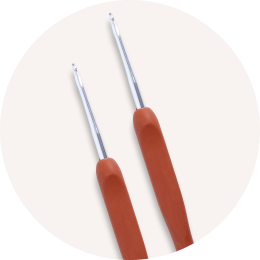
If hand fatigue is your limiting factor rather than sizing, a soft-handled option like the  Crochet Hook Set 9 Pcs with Soft Grip Handles covers the working range without the sizes that sit in the case untouched. For choosing which sizes you actually need, the walkthrough on picking hook size for any project without guesswork is a practical companion to this piece.
Closing Thoughts
The band number gets you into the right neighbourhood. Your hands decide the address. A crocheter who works tight will nearly always need to go up half a millimetre from the printed suggestion, and one who works loose will go down, and both of them are doing it correctly.
Make the swatch, wash it, hold it over your palm. Stiff means up, sloppy means down, and bends-but-holds means you have found it. Write the pairing on a scrap of paper tucked in with the yarn — hook size, brand, yarn weight — and you will spend the next project crocheting instead of recalibrating.
The number on the label was written for an average crocheter who does not exist. You do.
FAQ
My pattern calls for a 5mm hook and I only have 4.5mm and 5.5mm. Which do I use?
Swatch with both and choose by feel rather than by which number is closer. If you know you crochet tightly, start with the 5.5mm; if you work loosely, start with the 4.5mm. For anything without a required fit — a blanket, a cushion, a scarf — either will produce good fabric as long as you accept the finished piece will be slightly larger or smaller than stated.
The pattern specifies DK yarn but I only have aran. Can I still make it?
Yes, with two adjustments. Go up roughly one hook size — around 5.5mm or 6mm instead of 4.5mm or 5mm — and expect the finished piece to come out larger, because aran is thicker per stitch. For a square or rectangle, simply work fewer stitches and rows to reach the stated measurements; for a shaped garment, reswatch and recalculate before you start.
Can I use a knitting needle size chart to pick a crochet hook?
Not directly, even though both are measured in millimetres. Needle and hook recommendations on a yarn band are usually different numbers, because a knitted stitch and a crochet stitch use different amounts of yarn at the same diameter. If a band only lists a needle size, go up around half a millimetre to a millimetre for crochet and check the swatch.