Short answer
- A straight Tunisian hook holds every stitch of the row at once, so it comfortably handles pieces up to about 8 inches (20 cm) wide in worsted weight — roughly 30 to 40 stitches on a 14-inch hook.
- That width covers washcloths, hot pads, headbands, mug cosies, narrow scarves and seamed bag panels. It does not cover blankets, shawls or a cowl worked in one piece.
- Tunisian simple stitch curls because the fabric is too dense for the hook, not because you did it wrong. Going up two hook sizes from the yarn label's recommendation removes most of the curl with no blocking.
- Pick patterns that mix front-loop and back-loop stitches, or that end in a worked border — both hold flat far better than plain Tunisian simple stitch.
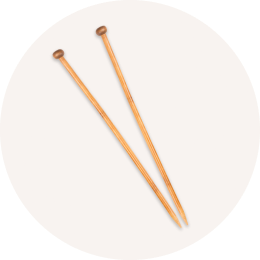
A straight Tunisian hook — the long, single-ended one, sometimes sold as an afghan hook or a crochet hook with needle end — makes anything narrower than roughly 8 inches. Washcloths, hot pads, headbands, mug cosies, narrow scarves and flat bag panels you seam afterwards are all within reach on day one. The limit is not your skill. It is that every live stitch in the row has to sit on the shaft at the same time, and a straight hook only has so much shaft.
The real trouble starts earlier than width. Most patterns filed under needle crochet were written for a standard hook and then adapted, so they carry a gauge that turns Tunisian simple stitch into a scroll the moment you take it off the hook. If you are still sorting out what the term even refers to, this breakdown of the four crafts people call needle crochet clears up which tool you actually have in your hand.
Width Comes First: Count Stitches, Not Inches
Measure your hook from the tip to the stopper at the end, then subtract about an inch — stitches crowded against the stopper slide off. A 10-inch hook gives you around 9 usable inches of shaft, and stitches in worsted weight sit about a quarter of an inch apart when they are not squeezed. That is roughly 35 stitches, which in Tunisian simple stitch at a loose gauge works out near 7 inches of finished fabric.
The mistake almost everyone makes on a first project is chaining to the pattern's stitch count without checking whether the hook can hold it. You find out on the forward pass of row one, with forty loops on the shaft and no room for forty-one.
Chain twelve fewer stitches than you think you need and swatch before you commit. Gauge in Tunisian crochet is wider and shorter than most people expect, so the piece grows sideways faster than the numbers suggest.
Can I seam narrow panels instead of buying a cabled hook?
Yes, and it often gives you a better result. Two 7-inch panels seamed up the centre make a 14-inch cushion cover, and the seam itself stiffens the join enough to fight curl along that edge. Work both panels from the same end so the return-pass ridges run in the same direction.
If you have never worked a forward and return pass before, spend an evening on a plain square first. Our walkthrough of Tunisian crochet basics using a simple swatch covers the two-pass rhythm without assuming you already know where the loop on the hook counts from.
Why Most Needle Crochet Patterns Curl on a Straight Hook
Tunisian simple stitch pulls forward at the bottom and inward at the sides because the return pass sits along the top of every row like a chain seam. Each row adds a small band of tension at the top and a column of vertical bars at the front, and the fabric resolves that imbalance by rolling. The denser your gauge, the harder it rolls.
Hook size is the lever, not stitch count. Take the hook the yarn label recommends for regular crochet and go up two sizes — worsted that calls for 5 mm wants 6.5 mm in Tunisian, and DK that calls for 4 mm wants 5 or 5.5 mm. The fabric will feel alarmingly loose on the hook and look completely normal once it is off.
Curl is a gauge problem wearing a stitch-pattern costume.
The second lever is the return pass. If you snug each yarn-over tight as you work back across, you are shortening the top of every row, which is exactly the force that makes the piece roll. Keep the return pass at the same tension as the forward pass and let the chain sit loose.
Hook shape matters here too, which is why two hooks marked the same millimetre can give you different results — the throat shape problem behind right hook, wrong gauge applies to Tunisian hooks just as much as standard ones.
Check these before you cast on
6 Beginner Tunisian Projects That Hold Flat
These six work because they are narrow enough for a straight hook and structured enough to resist curl. Three of them stay flat almost regardless of gauge. The other three need the hook bump described above, and will disappoint you without it.
Three that stay flat on their own
- Cotton washcloth, 30 stitches square. Cotton has no memory, so it does not spring back into a roll, and the piece is small enough that a border settles it completely.
- Hot pad or coaster set in Tunisian purl. Tunisian purl brings the working yarn to the front before each pull-through, which counteracts the forward lean of simple stitch almost exactly.
- Headband in Tunisian honeycomb. Alternating simple stitch and purl stitch across the row balances the tension in both directions, and seaming the two ends into a loop removes the last of the roll.
Three that need the hook bump
- Mug cosy in plain Tunisian simple stitch. Lovely dense fabric, and it curls hard at a tight gauge — but it is wrapped and buttoned around a cylinder, so a loose gauge plus a button band solves it.
- Narrow scarf, 24 to 28 stitches. Long, unsupported edges are where curl shows most. Two hook sizes up plus a slip stitch edging down both long sides keeps it lying flat over a coat.
- Tote panel bag, two rectangles seamed. Tunisian simple stitch makes the densest, least stretchy fabric of any crochet stitch, which is exactly what a bag that carries books wants.
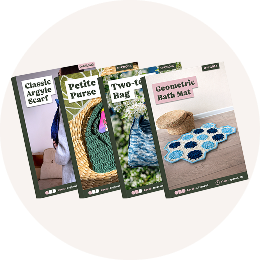
If bag shapes are what you are after, our  Crochet Bag Projects – Set of 6 Patterns is written for a standard hook — but the flat-panel constructions and strap placements translate directly to Tunisian panels once you match the finished measurements rather than the stitch counts.
Edges, Borders and the Stitch Everyone Drops
A worked border is the single most reliable anti-curl finish, and it costs one round. Work it with a standard hook in the same size as your Tunisian hook, one round of single crochet or double crochet all the way around, and the piece stops arguing with you. This is also why blocking is optional rather than essential — a border holds the edge mechanically, where blocking on acrylic holds nothing at all.
Before that, two edge stitches decide whether your piece has straight sides. The loop already on your hook counts as the first stitch of every forward pass, so you skip the first vertical bar — miss that and every row gains a stitch. At the other end, insert your hook under both strands of the final edge stitch, not one, or the side collapses inward row by row.
The border round is standard crochet rather than Tunisian, and double crochet gives a slightly taller, more flexible edge than single crochet. This short clip shows the double crochet motion at normal speed and slowed down, if it has been a while.
DOUBLE CROCHET FOR COMPLETE BEGINNERS

From the Hooks & Needles shop
Crochet Hook Set 16 Pcs with Case
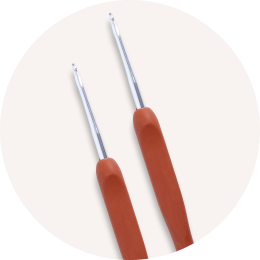
These are standard hooks rather than Tunisian ones, which is exactly what the border round needs — and having every size to hand is what makes the two-size hook bump a five-minute decision instead of a shopping trip.
When a Straight Hook Is the Wrong Tool
Blankets, shawls, wide cushion fronts and anything worked in one piece past about 10 inches need a cabled Tunisian hook, where the stitches slide off the shaft onto a flexible cord. Plenty of afghan hook patterns quietly assume you have one, because the craft is named after the afghans people used to make with it.
Double-ended hooks are a separate tool again, used for worked-in-the-round Tunisian and for two-colour fabric. A straight hook will not substitute, so check which hook a pattern specifies before you buy the yarn.
The honest answer for large pieces on a straight hook is panels. Six 7-inch Tunisian squares seamed into a lap blanket is a real project with a real finish, and each square is small enough that you can fix your gauge on square two instead of discovering it on row 300.
Ready to start a project you will actually finish?
Hooks & Needles delivers a complete yarn project to your door every month — coordinated yarn, the right hooks or needles, and a pattern written to be followed rather than decoded. Pause or cancel whenever you like.
Use LEARN20 for 20% off your first box

The Short Version
A straight Tunisian hook makes anything up to about 8 inches wide, and that covers washcloths, hot pads, headbands, mug cosies, narrow scarves and seamed bag panels. Width is decided by stitch count on the shaft, not by the pattern's ambitions.
Curl is a gauge problem. Go up two hook sizes from the yarn label, keep the return pass loose, and add a border round worked with a standard hook.
Choose a pattern that either mixes front-loop and back-loop stitches or finishes with a border. If it is plain Tunisian simple stitch with no edging and no hook guidance, it was probably adapted from a standard-hook pattern and it will roll.
FAQ
Is an afghan hook the same thing as a Tunisian hook?
Yes — same tool, different era of naming. You will see it sold as an afghan hook, a Tunisian hook, or a crochet hook with needle end, and all three describe a long single-ended hook with a stopper at the far end. The only meaningful distinctions are straight versus cabled, and single-ended versus double-ended.
Do I have to block Tunisian crochet?
Not if you fix the gauge and add a border. Blocking genuinely helps wool and cotton relax into shape, but it does almost nothing lasting on acrylic, which springs back as soon as it dries. Treat blocking as a finishing improvement rather than the thing holding your project flat.
Can I follow a regular crochet pattern with a Tunisian hook?
Not stitch for stitch, because Tunisian fabric is built from two passes and the stitch counts will not line up. What you can borrow is the shape: finished measurements, strap placement, seaming order and construction. Work to the pattern's dimensions in your own Tunisian gauge and ignore its stitch numbers.
Which yarn is easiest for a first Tunisian project?
A smooth worsted-weight cotton or cotton blend in a mid-tone colour. Cotton has no springback, so it curls less, and a smooth ply lets you see the vertical bars clearly — which matters enormously when you are learning where to insert the hook. Avoid fluffy, dark or heavily textured yarn until the stitch is automatic.
Which Tunisian stitch curls least for a beginner?
Tunisian purl, followed closely by honeycomb, which alternates purl and simple stitch across the row. Tunisian knit stitch looks the most like knitting and curls the most, because you are inserting the hook through the middle of the stitch and adding even more bulk to the front. Start with purl or honeycomb if you want a flat result without thinking about it.