Quick Summary
You bought a yarn described as cloud cotton, crocheted a baby blanket with it, and after three washes the surface looks fuzzy and tired. The problem is almost never the fibre — it is the construction, and three very different ones share that same soft-sounding name. By the end of this you will be able to look at a listing photo, name the construction, and predict how it will behave after ten washes.
Everyone squeezes the ball. You pick it up in the shop or you press the skein between your palms the moment the parcel opens, and you decide in half a second whether it is soft enough. What that squeeze is actually measuring is how quickly air leaves the strand and how quickly it comes back — not the fibre, not the quality, not the durability. It is a structure test disguised as a softness test.
That matters because cotton is a short-staple fibre, roughly 20 to 30 mm per fibre, with almost no natural spring. Any cotton yarn that feels cloud-like has been engineered to hold air, and there are three completely different ways manufacturers do it. They squeeze the same. They wash nothing alike.
Softness Comes From Trapped Air, Not From the Fibre
Loft in a cotton yarn is a construction decision. Wool crimps on its own and springs back when compressed, so a plain 4-ply wool already feels bouncy. Cotton does not crimp, so the mill has to build the air in — by wrapping short fibres around a core, by knitting a hollow tube, or by barely twisting the fibres at all.
Each of those methods buys softness by giving up twist, and twist is what holds fibre ends inside the strand. Less twist means more loft and more fibre ends sitting near the surface, ready to migrate out under friction. That migration is what you see as pilling.
Does higher cotton content mean it will pill less?
No, and this trips up a lot of shoppers. A 100% cotton chenille will shed more than a 60% cotton, 40% polyester plied yarn, because the polyester plies carry twist and lock fibres in place. Fibre content tells you how the yarn feels against skin and how it takes dye; construction tells you how it survives a laundry basket.
So the useful question is never "how soft is this." It is "what is holding the air in, and what happens to that structure when it gets wet, agitated and tumbled." Once you ask it that way, the three constructions separate immediately.
Softness you can squeeze out of a yarn in the shop is often the same softness that washes out of it in a month.
Three Constructions Get Sold as Cloud Cotton
The phrase is marketing, not a category. There is no standard behind it, no yarn weight attached to it, and no consistency between brands. A name tells you the intended feel, the strand tells you the build — which is why, with any soft cotton including our own  Cotton Cloud, the strand photo is worth more than the adjective.
Chenille cotton yarn
Chenille is a velvet caterpillar: short fibre tufts clamped between two twisted core threads, standing out perpendicular to the strand. It is the softest of the three to the hand and the most fragile in use. Those tufts are held by the cores alone, so abrasion pulls them free and the yarn goes bald in patches rather than pilling evenly.
It also worms. Chenille has almost no friction against itself, so stitches slide and a loop works its way loose into a little raised loop on the surface, usually within the first month of a blanket being used daily.
Hollow tube cotton yarn
Tube cotton yarn is knitted, not spun — a fine cotton yarn machine-knitted into a narrow tube, sometimes with a polyester filling inside, sometimes hollow. Cut one and it unravels like a tiny sock. Because the surface is already a knitted fabric, the fibre ends are locked into stitches rather than sticking out, so it resists pilling far better than chenille.
The trade-off is stitch definition and stretch. Tube yarn flattens under tension, so crochet stitches look softer-edged, and it grows lengthwise in a heavy blanket.
Loosely spun roving cotton
Roving-style cotton is a single strand with very low twist, sometimes gently wrapped with a fine binder thread. It has the most natural, matte look of the three and the best drape. It is also the one most likely to split under a hook and to thin out at high-wear points, because there is no second ply to redistribute the load.
Reading the Construction Off a Product Photo
You can identify all three from a listing image if the photo shows the strand at close range. Most good product photography does, because sellers want you to see the texture.
- Zoom to strand level. Fill your screen with a 3 to 4 cm length of yarn — if the photo falls apart at that zoom, treat the listing as unverified rather than guessing.
- Find a cut end. Chenille frays into loose tufts, tube yarn opens into a flattened ring or shows a stuffed core, roving simply fluffs apart into fibre.
- Look along the edge. Chenille has a fuzzy halo with a visible dark core line running through it; tube yarn shows tiny V-shaped knit stitches along its length; roving shows long diagonal fibre with a shallow twist angle.
- Check metres per 100 g. Around 80 to 120 m per 100 g suggests a bulky tube or thick chenille; 150 to 200 m suggests a lighter chenille or a roving single at aran weight.
- Read the care line against the construction. A 30 °C gentle-cycle instruction on a chenille is the manufacturer telling you the tufts will not survive a normal wash.
If a listing gives you none of this — no close crop, no metreage, no fibre split — that absence is information. Softness claims cost nothing to make.
Want the yarn, the pattern and the guidance in one box?
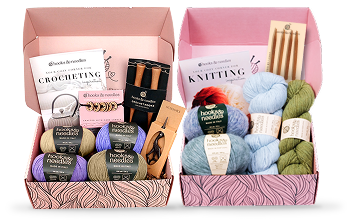
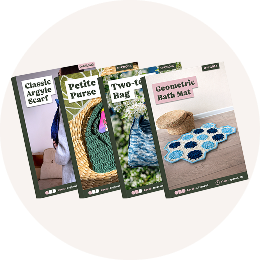
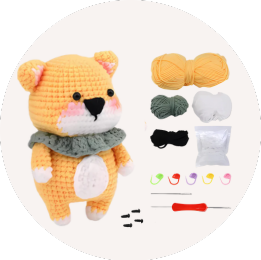
Each Hooks & Needles box arrives with the yarn, the tools and an exclusive pattern already matched to each other, plus instructions that do not skip the step you are stuck on. Nothing to source, nothing to substitute.
Use LEARN20 for 20% off your first box

What the Wash Cycle Does to Each One
Ten machine washes at 40 °C separate these three yarns decisively. Chenille loses tuft density first at the corners and edges of a blanket, where abrasion is highest, and the fabric develops a thin, shiny look. Tube yarn holds its surface but relaxes in length, often by 5 to 8 percent in a large piece. Roving cotton fuzzes evenly, then either settles into a soft halo or keeps thinning, depending on how much binder thread it carries.
For a baby blanket, that difference is the whole decision. A blanket gets washed more than any other handmade item in the house — weekly at minimum, daily during a bad month — and abrasion against a cot mattress is constant.
If the recipient has reactive skin, construction matters as much as fibre there too, which is covered in more depth in this guide to choosing soft yarn for sensitive skin without the itch. A shedding chenille puts loose fibre ends near a baby's face, which is a separate concern from softness.
For soft cotton yarn for babies that has to survive that schedule, a plied cotton is the conservative answer — something like  Cotton Blossom Yarn, where the twist is doing the work of holding fibre ends in rather than the structure being held together by a core thread.
Common Mistakes With Cloud Cotton
Substituting by weight category alone
Two yarns both labelled aran or category 4 can differ by 60 metres per 100 g once construction changes. The fix: match metreage per 100 g, not the category number, and swatch before committing — a chenille substituted into a roving pattern will eat a third more yarn than the pattern states.
Using a hook sized for the ball band
Chenille and tube yarn compress under the hook, so the band's suggested 5 mm often produces a dense, stiff fabric. The fix: go up half a millimetre to 5.5 mm and let the stitches stay open, since these constructions get their drape from loose fabric rather than from fibre. Hook diameter is only part of the story, as the comparison of two 5 mm hooks producing two different gauges shows.
Choosing a textured stitch pattern
Bobbles, cables and post stitches disappear entirely in chenille and blur in tube yarn, because neither construction holds a crisp edge. The fix: reserve textured stitch patterns for plied cotton, and give cloud constructions plain single or double crochet, or garter stitch if you are knitting.
Skipping the wash test on the swatch
A 10 by 10 cm swatch tells you nothing about pilling until it has been through a cycle. The fix: wash the swatch with a normal load, tumble it, then rub it hard between your palms for 30 seconds. Whatever pills in that half minute will pill on the finished blanket.
The Short Version
Cloud cotton describes a feeling, not a construction, and the three yarns hiding behind it behave differently under exactly the conditions a handmade blanket faces.
- Chenille: softest in the hand, sheds and worms, best for items washed rarely — cushion covers, throws for a sofa back.
- Tube or tape: holds its surface well, stretches lengthwise, good for bags, baskets and cot blankets with a firm gauge.
- Loosely spun roving: best drape and most natural look, splits under the hook, good for garments and wraps.
Zoom into the strand before you buy, match metreage rather than weight category, and wash the swatch. Twenty minutes of checking saves the blanket. If you want to go deeper into how fibre choice sits alongside construction, the breakdown of merino, alpaca and cotton for beginners covers the fibre half of the equation.
FAQ
Can I skip the wash test if the ball band says machine washable?
Machine washable means the fibre will not felt or shrink badly — it says nothing about pilling or tuft loss. A chenille can be perfectly machine washable and still go bald at the edges within ten cycles. One swatch through one real cycle is the only way to find out before you have invested 800 grams of yarn.
Can I use chenille cotton for a baby blanket anyway?
You can, and plenty of people do, but plan for a shorter life — roughly one to two years of weekly washing before the surface looks worn. Work it at a firm gauge to reduce worming, and avoid it entirely if the blanket will be dragged along floors or used in a car seat.
Do I really need to swatch for a scarf or a cushion cover?
For fit, no — a scarf that comes out 8 cm wider is still a scarf. For yarn quantity, yes, because construction changes metres per stitch dramatically and running out of a dye lot mid-project is a worse problem than a wide scarf. A 10 by 10 cm swatch also tells you whether the fabric drapes or boards up before you commit forty rows.
Can I swap one cloud cotton for another if the weight category matches?
Only if the metreage per 100 g is within about 10 percent and the construction is the same. Swapping a hollow tube for a chenille at the same stated weight typically changes gauge by one to two stitches over 10 cm and changes the drape completely. If you must swap across constructions, re-swatch and recalculate yarn quantity from scratch.