You have a pattern open in one tab and a yarn shop in another, and you have been flicking between them for twenty minutes without adding anything to a basket. The worry underneath is usually some version of: I will buy the wrong yarn, the thing will come out the wrong size, and I will have spent money to learn that. One of those fears is founded. Buying a yarn that behaves differently from the one the designer used will change your finished size, and no amount of careful stitching fixes it afterwards.
The colour you pick is not the risk. Yarn weight, fibre behaviour and yardage are. By the end of this you will know the order to source a first kit in, where the hours actually go, which decisions a curated box removes and which it does not, and what building your own crochet kit costs once you count the second shopping trip that almost always happens.
Start With the Pattern, Because Everything Else Hangs Off It
Pick the pattern before you touch a single skein. The pattern tells you the yarn weight, the yardage, the hook or needle size, the gauge you are aiming for and how many finishing steps you are signing up for. Choose yarn first and you are working backwards, hunting for a pattern that happens to suit what you already bought.
For a first project, read the pattern all the way through in the shop, not at home. You are looking for words you cannot picture. If a crochet pattern says "work in the back loop only" and you have no idea what that does to the fabric, that is fine — but you want to know it is coming before you commit money to yarn.
The single decision that makes this stage go well: choose a pattern whose finished size does not have to be exact. A scarf, a cowl, a cushion cover, a basket. Garments punish gauge errors. Rectangles absorb them.
- Choose the pattern. Rectangular or tube-shaped for a first make, so a half-stitch difference in gauge changes nothing that matters.
- Note the four numbers. Yarn weight category, total yardage, hook or needle size, and the gauge over 10 cm. Write them down before you shop.
- Match the yarn to those numbers. Weight category first, fibre second, colour last.
- Buy the tools. Hook or needle in the stated size, plus one size up and one down.
- Swatch before you commit. This is the stage everyone skips and the only one that predicts the outcome.
Matching the Yarn: Weight First, Fibre Second, Colour Last
Yarn weight is the thickness category — lace, fingering, sport, DK, worsted, aran, bulky, super bulky. Substituting across categories is the fastest way to end up with a scarf that is either a stiff plank or a lace curtain. If the pattern says worsted, buy worsted, and check the ball band's recommended hook or needle size matches the pattern's within a size or so.
Fibre is the second decision and it changes behaviour, not just feel. Wool has memory and springs back; cotton has none and grows under its own weight; acrylic sits somewhere between and does not respond to blocking, which is the wetting-and-shaping step that sets your stitches. A cotton version of a wool pattern will hang longer and drape flatter every time.
Can I substitute a wool blend for the pure wool a pattern calls for?
Usually yes, as long as the weight category matches and the blend is mostly wool. Watch for superwash treatments, which relax more than untreated wool and can add several centimetres of length to a hanging garment. Blends with a lot of plant fibre or silk will drape more and bounce back less, so swatch before you decide.
Colour comes last because it is the only choice you cannot get wrong structurally. It is also the one that eats the most time in a shop. Curated boxes remove this decision entirely, which some crafters love and some resent — worth knowing which one you are. If where the fibre comes from matters to you, it is worth reading the account of why Hooks & Needles sources its yarn from European mills before you compare it against a supermarket acrylic on price alone.
Buying Enough: Yardage, Dye Lots and the Second Trip
Buy by yardage, never by number of balls. Two skeins of worsted from different brands can differ by 60 metres, and the pattern's "4 balls" refers to the designer's yarn, not yours. Divide the pattern's total metreage by the metreage on your ball band, then round up.
Then add one extra ball, matched to the same dye lot. The dye lot is the batch number printed on the band, and two balls of the same shade from different lots will show a visible line where you join them. Shops restock constantly; the lot you need in three weeks will be gone.
Crochet uses roughly a third more yarn than knitting to cover the same area. If you are converting a knitting pattern's yardage for a crochet project, or working from a rough estimate, that margin is the difference between finishing and running out with one border left.
The second trip is where DIY kits quietly lose their cost advantage. Petrol, postage, or a minimum-order threshold you now have to reach.
Tools and Notions: The Short List That Is Never on the Pattern
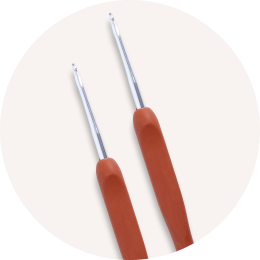
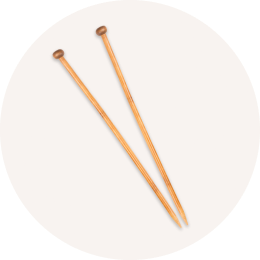
Buy the hook or needle size the pattern names, plus one size either side. That is not overspending — it is the only mechanism you have for fixing gauge, and you will need one of them. Tension is how tightly you hold and form the yarn; gauge is the measurable result. You change gauge by changing hook or needle size, not by trying to stitch differently.
Chunky and super bulky projects need hooks most shops carry in limited sizes, and a mismatched large hook makes stitches that look loose and holey rather than plush.

From the Hooks & Needles shop
Large Crochet Hooks for Chunky Yarn
If your first project is a chunky blanket or basket, these cover the larger sizes that most starter hook sets stop short of — including the one up and one down you need for adjusting gauge.
Then there are the notions no pattern lists because the designer assumes you own them. This is the part of a DIY kit that gets forgotten and stalls a project at nine at night.
Swatch Before You Commit, Even Though You Do Not Want To
A gauge swatch is a test square, worked in the pattern's stitch with the pattern's hook or needle, measured against the pattern's stated gauge. It costs you twenty minutes and one evening's worth of patience. It is the only stage that tells you the truth before the yarn is spent.
Make it bigger than 10 cm square — around 15 cm — and measure in the middle, away from the edges where stitches distort. Count stitches across 10 cm and rows down 10 cm. Stitch count controls width; row count controls length.
If you have more stitches per 10 cm than the pattern, your gauge is tight: go up a hook or needle size. Fewer stitches means loose: go down a size. Change the tool, swatch again, and stop when the numbers match.
For anything wool or wool-blend, wash and dry the swatch the way you will wash the finished thing. Superwash wool in particular relaxes when wet and can add several centimetres to a finished length.
Common Mistakes When You Build Your Own Crochet Kit
Buying the yarn you fell in love with, then finding a pattern
Fix: keep the yarn, but search patterns by its weight category and yardage rather than by what you had imagined. Most yarn shops list their stock by weight for exactly this reason.
Ordering exactly the number of balls the pattern names
Fix: recalculate from metreage on your ball band, then add one ball in the same dye lot. The unused ball costs less than the trip you would otherwise make.
Working a dark yarn under a lamp and losing the stitches
Fix: change the light before you change the yarn. Navy, charcoal and black hide stitch definition badly, and most first-project frustration with dark yarn is a visibility problem rather than a skill one. A lit hook such as the  LED Crochet Hooks: 11-in-1 Rechargeable solves it at the point where the stitch is formed.
Skipping the swatch on a garment
Fix: swatch anyway, or switch to a project where size does not matter. Those are the two honest options. There is no third one where you stitch carefully enough to compensate.
Buying a 12-piece hook set for a project that needs one hook
Fix: buy the stated size plus one either side for the first project, and expand later once you know which sizes you actually reach for. A set bought blind usually leaves eight sizes untouched.
Hooks and Needles vs DIY Yarn Kit: the Hours and the Money
Sourcing a first kit yourself takes two to four hours spread across pattern reading, yarn comparison, yardage maths and checkout. That is real time, and it is time spent on decisions rather than on stitching. Experienced crafters often enjoy that part. People who want to make something this week generally do not.
On money, the DIY route can come out cheaper if you already own tools and buy yarn on sale. It rarely does on a first project, because you are buying hooks, notions and a pattern alongside the yarn, and because the second trip for extra yarn is a common outcome rather than a rare one. There is a line-by-line comparison of box cost against buying yarn and patterns separately if you want the arithmetic rather than the summary.
What curation removes: the weight-matching decision, the yardage calculation, the dye lot risk, the hook size guess, and the chance that the pattern assumes a technique it never explains. What it does not remove: your gauge swatch. That is still yours to work, because gauge depends on your hands.
The honest trade is control for time. Curated vs DIY yarn is a choice between picking every element yourself and having the compatibility decisions already made — and for a first finished object, compatibility is what decides whether it gets finished.
Ready to start a project you will actually finish?
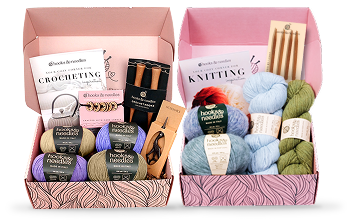
Hooks & Needles delivers a complete yarn project to your door every month — coordinated yarn, the right hooks or needles, and a pattern written to be followed rather than decoded. Pause or cancel whenever you like.
Use LEARN20 for 20% off your first box

What To Do Next
If you are sourcing your own kit, do it in the order above and do it in one sitting. Pattern, then weight, then yardage plus one, then tools, then swatch. Splitting it across several evenings is how balls get bought in different dye lots.
If you would rather spend the evening stitching than comparing ball bands, a curated box hands you a project where the compatibility work is done. Either way, swatch first — that step belongs to you regardless of where the yarn came from. It is worth knowing what to check before committing to a first yarn subscription so the box that arrives matches the craft and skill level you actually work at.
What to remember
- Choose the pattern before the yarn, and note its weight, yardage, tool size and gauge before you shop.
- Match yarn weight category exactly; treat fibre as a behaviour choice, not a comfort one.
- Buy by metreage, add one ball, and keep every ball in the same dye lot.
- Fix gauge by changing hook or needle size, never by stitching differently.
- A curated box removes the sourcing decisions but not your swatch.
- Crochet uses about a third more yarn than knitting for the same area.
FAQ
My gauge is half a stitch off over 10 cm. Do I need to redo the swatch?
For a scarf, cowl or blanket, no — half a stitch across 10 cm changes the finished width by a couple of centimetres and nothing else. For a garment, yes. That half stitch multiplies across 100 stitches into roughly a full size difference, and it only ever goes the wrong way.
I ran out of yarn and the dye lot is sold out. What now?
Do not join the new lot at a random point. Work the remaining sections so the change lands somewhere structural — a border, a second sleeve, alternating rows with the old lot for ten rows to blend the transition. Alternating is the most reliable fix and it hides the join almost completely.
The pattern says worsted but my shop only has DK. Can I use it?
You can, with adjustments. DK is thinner, so your fabric comes out smaller and looser at the same hook or needle size. Swatch with a smaller tool and expect to need more length or more stitches. On a rectangle this is easy; on anything shaped, find worsted instead.
My edges are getting narrower as I go. What am I doing wrong?
In crochet, you are almost certainly missing the last stitch of each row, which is easy to lose in the turning chain. Count your stitches at the end of every row for the next ten rows. In knitting, a narrowing edge usually means dropped stitches at the selvedge rather than tension.
Do I have to block, or is that optional?
Wool and wool blends: block. Wetting and pinning the piece to shape evens out stitch irregularities and sets the dimensions, and it makes a noticeable difference to how a first project looks. Acrylic does not respond to wet blocking in the same way and mostly stays as it came off the hook.